Early Career Liaison Kailani Acosta Advances Ocean Science at the 2025 UN Ocean Conference
Program News
By Sydney O’Shaughnessy
Last update September 16, 2025
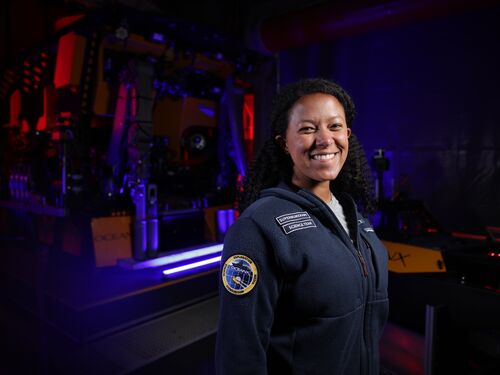
Photo Credit: OceanX Media
In 2023 and 2025, the United Nations held global ocean conferences to support the implementation of Sustainable Development Goal 14, which aims to conserve and sustainably use the oceans. The 2025 UN Ocean Conference (UNOC), held in Nice, France, focused on how to accelerate and mobilize more action for ocean conservation.
We spoke with U.S. Ocean Decade Early Career Liaison Kailani Acosta about her work as part of the Early Career Ocean Professional (ECOP) Network Programme under the UN Ocean Decade. Acosta attended the 2025 UNOC, where she helped host the well attended deep ocean pavilion.
This was your first time attending UNOC. What stood out to you most about the experience?
The most unique part of the UNOC experience was the audience. Compared to other UN climate meetings I’ve been to, UNOC allowed for a lot more public interaction with research, policy, and scientists. It was incredibly uplifting to see the support and interest in our oceans from so many different groups of people, from classrooms of young students to older retirees, to scientists from all over the world.
You helped host the deep ocean pavilion at UNOC. Can you describe how the pavilion came together and what your role was in the process?
The Deep Blue Pavilion at UNOC came together as a truly collaborative effort. It was built on the generous support, imagery, and video shared by ocean science and exploration organizations, led by OceanX and including MBARI, Schmidt Ocean Institute, Scripps Institution of Oceanography, OceanQuest, Avatar Alliance, and WHOI. At OceanX, our team worked closely with the exhibition designers at WMH Project France to shape the Pavilion’s concept and visitor experience. My role focused on curating scientific content and storytelling to highlight the extraordinary diversity and adaptations of life in the deep ocean. We created an immersive journey that brought audiences of all backgrounds into the rarely seen depths of our planet’s ocean, producing a deeper appreciation for why these ecosystems matter.

Over 100,000 people visited the pavilion. What was it like to engage with such a broad audience?
It was an incredible experience to interact with so many different people in Nice through the Pavilion. We welcomed everyone from heads of state and policy leaders to scientists, students, artists, and members of the public who were simply curious about the ocean. Each group came with different perspectives and questions. Some people wanted to understand the science behind deep-sea ecosystems, others were fascinated by the technology that makes exploration possible, and many were in awe of the imagery and stories from the deep ocean.
Immersive storytelling can be so powerful in connecting people to the deep ocean—a place most people will never see firsthand. We watched perspectives shift in real time from thinking of the deep ocean as distant and abstract, to recognizing it as a vital part of the Earth’s system. The diversity of engagement reinforced why public-facing efforts like the Pavilion are so important: they bridge science, policy, and public imagination in ways that can inspire action.
As an Early Career Liaison for the US National Decade Committee of the Ocean Decade, what does this role mean to you?
The role of an Early Career Liaison is one of connection and communication. In times like these, where many are worried about the future of science in the US, it is necessary to build inclusive and solution-oriented committees working together on making the Ocean Decade work as impactful as possible. It’s important to have focuses on early career scientists, especially in spaces like these, where early career participation and training is essential globally to carry out needed research and protect the ocean beyond the Ocean Decade.
What do you see as the Ocean Decade’s biggest success so far, especially when it comes to supporting ECOPs?
The Ocean Decade’s focus on ECOPs and creating platforms for ECOPs has been incredibly powerful for uniting young marine scientists globally. The ECOP program has created an amazing network and space for mentorship and capacity-building. This work is so necessary for creating international ECOP cohorts that are doing impactful work in many different spheres. OceanX’s UN Decade endorsed action, the Around Africa Expedition, greatly benefitted from the Ocean Decade’s support and creation of ECOP coalitions, as we had an incredible number of ECOP applicants and amazing Early Career Explorer Cohorts on our expedition. These ECOP cohorts were trained in eDNA, oceanography, marine technology and science communication and created projects that they are currently working on together to build on the skills we gained together.
What advice would you give to other ECOPs hoping to get involved in major global events like UNOC?
My advice would be to get involved and reach out to as many people as possible doing work you are interested in, attend events and get involved in programs to build skills and make connections. There is a lot of momentum around creating networks and platforms for ECOPs to get involved in scientific cruises, workshops, working groups and conferences. Let’s make sure these efforts continue far beyond the decade as well!