Offshore Energy in the Gulf 15 Years after Deepwater Horizon
Program News
By Lauren Alexander Augustine
Last update April 22, 2025
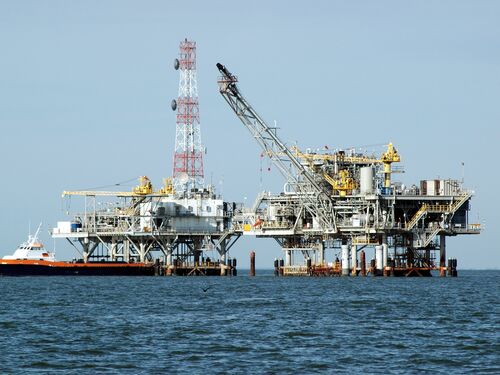
Gas rig with multiple components and crewboat docked. Off the coast of Alabama in the Gulf of Mexico.
It is now 15 years since an explosion ripped through the Deepwater Horizon, an oil rig operating in the Gulf Coast region, triggering the worst oil spill to occur in U.S. waters and one of the worst environmental disasters in U.S. history. Eleven workers lost their lives, and 134 million gallons of oil flowed from the wellhead before it was finally capped 87 days later. The tragedy put a national spotlight on the risks associated with offshore drilling and exploration as well as on the Gulf, a unique American landscape rich in economic, natural, ecological, and cultural resources.
In the aftermath of the Deepwater Horizon blowout and resulting oil spill, $500 million in criminal penalties were set aside in an endowment at the National Academy of Sciences for its new Gulf Research Program to “carry out studies, projects, and other activities” focused on offshore energy production, human health, and environmental protection in the Gulf region and along the U.S. Outer Continental Shelf.
The Safety of Offshore Oil and Gas Production
Is the offshore environment safer now than in 2010? There are grounds for optimism. A 2023 National Academies consensus study determined that the offshore industry in the Gulf has shown considerable improvement in systemic risk management, due to reforms implemented in response to the Deepwater Horizon spill. These reforms include major investments in improving offshore safety on the part of industry and government. For its part, the GRP has awarded over $20 million in grants as part of its Safer Offshore Energy Systems program, which aims to decrease overall risk, reduce the likelihood of a catastrophic accident occurring, and — should an incident occur — lessen the severity of consequences to people and the environment. But the National Academies study also found that while progress has been made, work remains to be done in establishing an industry-wide, industry-led commitment to a culture that supports safety.
Assessing the current safety of offshore operations is not a straightforward task. Vigilance is important because a major lesson of the Deepwater Horizon blowout and resulting oil spill is that the underlying risks of offshore operations are not static and shift over time. Although there hasn’t been a subsequent blowout similar to Deepwater Horizon, other risks have come to light, including spills associated with aging infrastructure. The Offshore Situation Room (OSR), a serious gaming exercise convened by the GRP in 2021 examined some of these emerging risks, including legacy infrastructure and the potential for cyberattacks.
A central insight emerging from the OSR was the importance of dialogue between stakeholders, including community representatives. As a follow-up, the GRP has convened a set of workshops bringing together representatives from the Gulf and Alaska, the two regions affected by the most serious offshore oil spills in U.S. history, to share their experiences, knowledge, and best practices with the aim of helping communities prepare for and recover from potential future oil spills.
Another key lesson of the Deepwater Horizon blowout and resulting oil spill was how little was understood about fundamental baseline conditions of the Gulf. The GRP has made a major contribution to addressing this gap through a substantial investment in supporting better understanding of the Gulf of America’s Loop Current. Thanks to GRP’s Understanding Gulf Ocean Systems (UGOS) initiative, the Gulf is now one of the most intensively sampled bodies of water in the world, providing the foundation for improved decision-making related to weather events and offshore energy production.
Looking Ahead
The future of the region’s energy sector remains a source of debate. While the long-term direction appears to be toward a more diverse, less carbon-intensive energy mix, there is significant disagreement about the appropriate speed of change and how it should unfold. The potential for natural gas to serve as a lower-polluting “bridge” fuel on the way to a cleaner energy future is one source of contention, as is the economic feasibility of emerging technologies such as carbon capture, utilization, and storage (CCUS).
In 2022, the GRP tapped the expertise of a diverse set of stakeholders from academia, industry, communities, and government, to grapple with key issues around a regional energy transition through a set of serious games and interactive demonstrations, including how best to incorporate the perspectives of communities most affected. Recognizing that a key to the region’s continued energy leadership is a prepared energy workforce, the GRP is supporting education and training opportunities to students ages 16-25 to give them the skills to carry out the jobs of the future.
Over the next few years, the GRP will launch efforts to
support the next generation of Gulf-based researchers' ability to get into the field quickly in the event of another spill to better understand economic and community impacts,
assess the role of liquid natural gas in the new energy economy of the Gulf,
work with state and federal governments on the vexing question of how to address “legacy” infrastructure that remains in place without a responsible party,
convene experts to consider new developments related to energy security and emerging threats,
continue to support the “new-collar” workforce, that will be the next generation of energy leaders and workers of the Gulf region
and survey Gulf residents to better understand their perspectives on their energy future to ensure GRP’s work is resonant and relevant to the region this program serves.
Fifteen years after Deepwater Horizon, offshore energy production remains a vital part of the region’s economy. Traditional oil and gas exploration continues, as new technologies like offshore wind, CCUS, and “blue” hydrogen expand energy options. The dynamic changes in the energy sector are occurring against equally dynamic changes occurring in the Gulf environment and communities. The nature of the energy-environment nexus in the Gulf is not static, nor is the risk profile of the offshore environment. Smart applications of scientific, engineering, and medical knowledge remain vital to ensure that the people of the Gulf have a safe, resilient, and prosperous future.
Lauren Alexander Augustine is the executive director of the Gulf Research Program at the National Academies of Sciences, Engineering, and Medicine.