The Future of Youth Development: Building Systems and Strengthening Programs (2025)
Chapter: 3 OST Systems
3
OST Systems
Human ecological theory examines the nested contexts of family, community institutions, and social systems within which learning and development take place. Chapter 2 offers critiques and expansions of this theory as they relate to children and youth in out-of-school-time (OST) settings. In this chapter, the committee builds off these discussions to apply a systems perspective to OST. The chapter first presents the concept of the learning and development ecosystem and then delves into the OST ecosystem, which is made up of multiple overlapping systems that not only shape learning and development within programs but also can shape how programs are developed, delivered, and accessed, as well as the experiences of young people within those programs. We identify subsystems and sectors within the OST ecosystem that serve as key opportunities to improve program access and quality. Finally, we discuss the role of coordination and investments in OST systems through intermediary organizations and philanthropy.
APPLYING A SYSTEMS PERSPECTIVE TO OST
Systems may be considered using the hierarchical, nested framework described by Bronfenbrenner’s (1979) bioecological model: microsystem, mesosystem, exosystem, macrosystems, and chronosystem (described in Chapter 2). Systems can also function in a heterarchical way, meaning elements in the same level (i.e., lateral) or from lower to higher levels can have influential relationships (Peck, 2007)—this is important for considering complex systems such as learning landscapes (Tebes et al., 2014).
The concept of the learning and development ecosystem has taken some salience in the youth development field, as it helps people consider how multiple settings affect children and youth. Akiva et al. (2022) define learning and development ecosystems as “collections of people, places, and possibilities that constitute an environment full of learning and development opportunities—opportunities that particular youth will or will not actually experience within the ecosystem” (p. 14). They argue that to shift to ecosystem or systems thinking is to move from considering individual learners (as suggested by the bioecological model) to considering how a context works and how to shape it for the benefit of the community as a whole.
Figure 3-1 depicts the learning and development ecosystem within a city and how OST providers, OST systems, and intermediaries are situated within this ecosystem. Learning and development occur in complex—not just complicated—systems (Hecht & Crowley, 2019). That is, a complicated
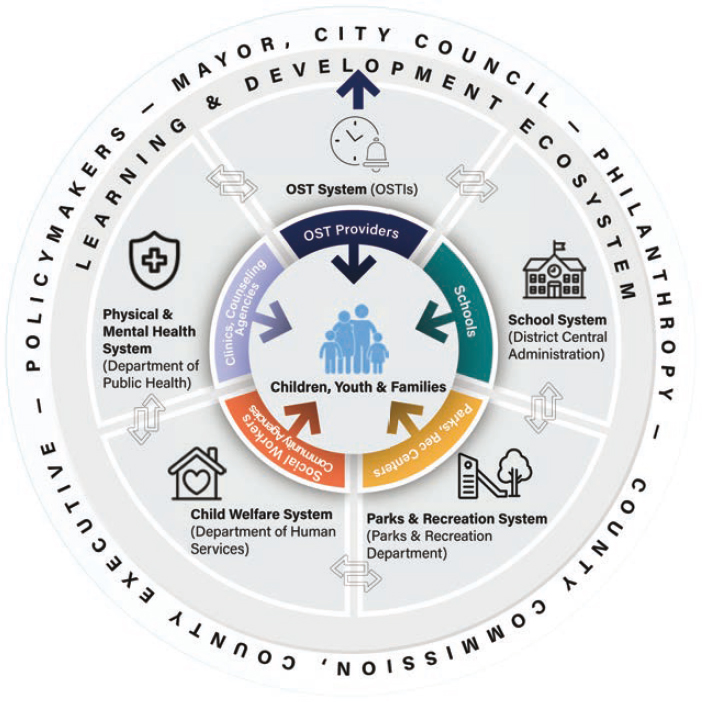
NOTES: OST = out-of-school-time; OSTI = OST intermediary.
SOURCE: Hartmann et al., 2024, p. 12.
problem (e.g., sending a rocket to the moon) is replicable, once achieved; a complex problem, however (e.g., raising a child) involves dynamic and uncertain variables, and the same practice may yield different results in different circumstances (examples from Snyder, 2013). When it comes to learning and development among the people, places, and programs in a given place, effecting change requires different practices than those designed for noncomplex systems. Ecosystem scholars have therefore called for using adaptive management strategies in learning and development ecosystems, including decentering individual learners, monitoring ecosystem health, and focusing on system-level initiatives (Akiva et al., 2022; Hecht & Crowley, 2019).
A common saying in manufacturing and quality control is “every system is perfectly designed to get the results it gets” (Proctor, 2008, para. 1). This suggests that results (in this case, academic achievement or other outcomes for individual young people) are linked to aspects of the system. A systems or ecosystems view can therefore provide an alternative to individually focused frameworks—these tend to involve deficit views in which children, youth, and families are held accountable for individual academic performance, despite systemic patterns that affect that performance (Baldridge, 2019). In this sense, systems thinking has the potential to disrupt deficit views. Systems thinking considers all the factors that shape patterns, rather than focusing on why particular children and youth do not succeed.
OST (ECO)SYSTEM
Several subsystems or sectors within an OST ecosystem can have a direct influence on learning and development in OST programs; such subsystems can also interact with OST systems, programs, staff, and participants in ways that impact program development, delivery, and accessibility. These subsystems include families, transportation, education, health care, workforce, and the juvenile justice system.
Families
Family engagement plays a critical role in OST programs. Aside from influencing their children’s decisions to participate (or not) in various activities, family members are involved in OST in a variety of other ways. Parents and caregivers support and encourage their children’s OST interests and often dedicate substantial time and financial resources to these activities, including shuttling them to and from program facilities and managing conflicting engagements. According to the Global Family Research Project,
Just as families play many roles in children’s and youth’s lives, they play many roles in OST. Family engagement in OST includes activities that happen in the schools and sites where programs are located—for example,
through parent volunteer work and participation on committees. However, family engagement also includes all of the family beliefs, attitudes, and behaviors that influence children’s development and learning within OST settings. This can include supportive parenting that aligns with program expectations for behavior, encouraging a child’s OST participation, helping a child or adolescent make informed choices about programming, discussing a child’s progress in the OST program with staff, reinforcing skills from the program at home, and being an advocate for and/or leader in the program. (Bouffard et al., 2011, p. 5)
Additionally, some programs may be specifically designed with a family engagement component. One such program is the federal 21st Century Community Learning Centers (21st CCLC) program, which allows OST programs to spend funds on family literacy and other engagement activities (Bouffard et al., 2011). Emerging research points to the need for dual capacity-building of families and institutions in creating essential conditions, such as relational trust and collaboration, to increase strong family–program partnerships (see Mapp & Bergman, 2019). Chapter 4 further discusses the role of families in OST participation.
Transportation
Getting to and from OST activities is consistently named as a key challenge to OST attendance and growth (Patel et al., 2021). This can be an accessibility issue in both urban and rural settings (Afterschool Alliance, 2021; Sanderson & Richards, 2010). This is true for schools as well, as school-related transportation challenges have been linked to negative academic outcomes (Hopson et al., 2022). Programs and communities address this challenge in numerous ways. Sometimes programs or collectives of programs purchase vans to transport participants. In cities with reliable public transportation, programs sometimes purchase bus or subway passes for participants. In the AfterZone Model in Providence, Rhode Island, for instance, children, youth, and families sign up for their local AfterZone, which gives them access to multiple programs and safe transportation to and from the facilities, as arranged by the city intermediary (Kauh, 2011). Chapter 4 further discusses the role of transportation in OST participation.
Education
OST programs and networks of programs interact with the schooling sector in multiple ways. Many programs send staff into schools to lead activities, both for enrichment and recruiting children and youth to their programs, a practice that has been called “insert programs” (Akiva et al.,
2015). Field trips to destinations such as museums and nature centers are also common in OST programs (DeWitt & Storksdieck, 2008). Some cities partner with school districts to provide programming; for example, the City of Aurora, Colorado, has a long-standing relationship with Aurora Public Schools and combines city and school district resources to provide the Community of Many Providing After School Success (COMPASS) program. The OST program serves eight schools, with city staff providing enrichment programming and school district staff, providing academic programming (City of Aurora, n.d.). The COMPASS program sits in the city manager’s office and the city council has shown strong support for the program through funding allocations. Programming is partly supported by one-time funding, such as youth services allocations from the city, which require a certain percentage of participants to qualify for free or reduced-price lunch. When selecting program locations, city staff prioritize schools in lower-income communities. The school district selects participants based on need, as indicated by factors such as income level and the need for academic support (Stockman, 2024).
Scholars have studied what it takes to conduct partnerships between schools and OST programs. In 2016, the Wallace Foundation funded a six-year project, the Partnerships for Social and Emotional Learning Initiative, that brought together school districts and OST programs in six communities across the United States to learn whether and how children benefit when schools and OST programs partner to improve and align social and emotional learning (SEL) activities (Schwartz et al., 2020). Implementation was an important focus for these partnerships, and analysis suggests several factors that may support implementation; these include short SEL rituals, integrating SEL, and the importance of SEL for adult leaders (Leschitz et al., 2023).
In the United States, OST programming is often seen as an add-on or complement to schools—which is not universal across the world. That is, in the United States, the value of OST is often considered in the context of school goals—OST participation is considered valuable if participation leads to academic achievement gains. This is evident in the history of legislation for the 21st CCLC program, whose primary goal is supporting students in meeting state academic standards (Elementary and Secondary Education Act, 1965). In contrast, in a 2018 resolution the Council of the European Union (2018) officially defined youth work as follows:
Youth work is a broad term covering a large scope of activities of a social, cultural, educational or political nature both by, with and for young people. Increasingly, such activities also include sport and services for young people. Youth work belongs to the area of “out-of-school” education, as
well as specific leisure time activities managed by professional or voluntary youth workers and youth leaders and is based on non-formal learning processes and on voluntary participation. (p. C 441/6)
Halpern (2006) called this notion—that OST programs should be evaluated solely based on their capacity to enhance academic achievement—“the big lie” and argued that holding them accountable to such goals distracts from their real value. He stated, “After-school programs are well suited to providing the types and qualities of developmental experiences that other institutions (e.g., the schools and public play spaces) can no longer provide for most low- and moderate-income children” (Halpern, 2006, p. 112). He described afterschool activities further: “These experiences, whether in the arts, humanities, sciences, civics, physical activity, or other domains, include play and sheer fun, exploration, and learning from adults skilled in different domains” (Halpern, 2006, p. 112). Indeed, OST programs are wide ranging and can lead to positive outcomes for children and youth in the multiple areas considered in this report, as discussed further in Chapters 6 and 7.
Higher Education
Higher education plays three core roles associated with OST programs: building the capacity of youth development practitioners, exposing college students to employment opportunities in the sector, and conducting research and evaluations that advance the youth development field.
First, higher education contributes to the preparation of the next generation of youth development practitioners through certificate and degree programs. According to the National AfterSchool Association’s (NAA’s) member survey (2017), 25% of its members hold an associate’s degree, 41% bachelor’s, and 30% master’s degree or doctorate. At the fieldwide level, two-thirds of OST program staff have a bachelor’s degree or higher, primarily in liberal arts and education, with younger staff holding a high school diploma or associate’s degree (American Institutes for Research, 2025).
The NAA’s (2023) core competencies document outlines ladders of professional progression and associated applicable higher education trajectories. Many statewide afterschool networks have adopted standards and pathways aligned with the NAA core competencies. This has signaled further advancement of the field, and many well-established and emerging programs are conferring degrees that are preparing youth development practitioners (e.g., University of California, Irvine’s Certificate in Afterschool and Summer Education; University of Minnesota Youth Studies Program; The City University of New York Youth Studies Consortium).
Second, higher education institutions have developed partnerships to place students into practicums or other workforce development experiences (e.g., internships, summer jobs) within OST programs. For instance, the University of Pittsburgh’s Collegiate YMCA supports students’ leadership development through service on campus and in OST programs in the community as part of a practicum, or practical experience. The Posse Foundation has numerous partnerships with higher education institutions (public and private 4-year institutions across the country) to support Posse Scholars, including pathways in OST programs. Horizons National partners with universities to build OST programs, including staff capacity-building.
Third, higher education plays an important role in advancing research and evaluation of the youth development field through rigorous studies and community partnerships designed to support local OST programs and contribute to the advancement of knowledge in youth development. For example, the University of Colorado Boulder, through its Institute of Behavioral Science,1 manages Blueprints for Healthy Youth Development,2 a clearinghouse that offers a comprehensive registry of evidence-based and scalable youth development interventions shown to be effective in reducing antisocial behavior and promoting a healthy course of youth development and adult maturity. University research centers—such as the University of Virginia’s Youth-Nex center, which includes OST as one of three core research domains—are among a growing number of examples of higher education’s role in advancing the youth development field. Chapter 5 offers future discussion on higher education for the OST workforce.
Health and Wellness
The health care sector interacts with OST settings to support the well-being of children and youth, particularly individuals with health conditions that require professional health care intervention. The Centers for Disease Control and Prevention (CDC, 2021) reports that at least 40% of children and youth in the United States have at least one chronic health condition (e.g., asthma, diabetes, cerebral palsy). Children living at or below the poverty level have a 30% increased risk of having a chronic condition (American Academy of Pediatrics, 2021). Effective management of these conditions is essential to ensure healthy development and academic success (American Academy of Pediatrics, 2021). A common way the health care system interacts with OST programs is when an OST program is linked with a community schools model, where health care is a component of a whole-child, whole-school approach, and children are offered in-school
___________________
access to dental, physical, and mental health services, supports, and referrals (CDC, n.d.). OST programs commonly offer health fairs to ensure that families have exposure and educational opportunities about their health and the health of their families, and that they can connect with providers (Action for Healthy Kids, n.d.). Finally, OST programs often have goals to improve health and minimize health risks such as obesity through healthy activity, play, and nutrition. Multiple national models support participants’ health and wellness, including Girls on the Run and the National Recreation and Parks Association.
The ways in which OST programs address the chronic or serious health care needs of children is not well documented. Programs that are sponsored by public schools or federally funded are required to provide access to services to care for children with significant health care needs. School nurses can serve as a bridge between the OST and health systems and can play a role in coordinating health care between the school day and OST programs; however, they are not utilized often (National Association of School Nurses, 2024). For children and youth with minor health needs, this may not be particularly problematic. However, for individuals with more complex health needs, such as asthma or diabetes, the burden is on family members to solve how their child’s needs may be met in an OST setting. For example, children and youth with special health care needs may require specific medications or care that OST staff may not be authorized or trained to provide. As a result, parents’ options may include not enrolling their child in extracurricular enrichment activities, providing the special health care themselves, or risking their child’s health by accepting care from untrained OST staff. Given that young people from low-income communities are known to have higher rates of chronic conditions (American Academy of Pediatrics, 2021; Houtrow et al., 2020; Kids Count Data Center, 2023), the propensity for differential access to OST participation is large.
Workforce
As noted in Chapter 1, interest and investment in OST programs is driven in part by the fact that it provides childcare for the children of working parents and that it helps prepare young people to enter the workforce. In the United States, major shifts in the labor market (e.g., gig economies, remote work) may affect supply and demand, as well as factors such as transportation needs, for OST programs. Shifts in attracting and retaining the OST workforce may result as well, as practitioners may find incentives to work in other sectors. Additionally, OST programs may offer local job fairs that may provide families and community members connections with employers, access to job training and/or resume support, access to the technology required to search and apply for jobs, and family-focused skill development opportunities.
OST programs also may offer skills for the next generation of workers, as evidenced by an increased emphasis on science, technology, engineering, and mathematics (STEM) in the youth development field (see Box 3-1) and apprenticeships.
Summer youth employment programs are on the rise in major cities, and early evidence suggests that they provide meaningful pathways to skill development, job placement, and reducing harmful activities during the summer months (Davis & Heller, 2020). These programs promise to be sustainable, with access to workforce investment funds for bringing together workforce and youth development organizations.
In addition, several national and local models, as well as funding, are available for career preparation through internships, apprenticeships, etc. Most notably, Job Corps is a 60-year-old Department of Labor investment that supports youth ages 16 and older to access job training, along with other basic supports (e.g., education, housing [Schochet et al., 2001]). See more on the OST workforce in Chapter 5.
BOX 3-1
Million Girls Moonshot: A STEM-Focused OST Initiative Applying a Systems Approach
Million Girls Moonshot equips out-of-school-time (OST) programs to eliminate barriers to STEM and foster engineering mindsets. Supported by the STEM Next Opportunity Fund, the Moonshot initiative identifies high-quality program models and resources that are accessible, research informed, and girl based, then brings them to scale with over 18 national partnerships. Million Girls Moonshot does not create new programs because this is not where the need exists in the STEM learning landscape. Rather, the initiative encourages program facilitators to use best practices for engaging girls in STEM, leveraging the existing infrastructure of the 50 State Afterschool Network (n.d.), which partners with the Charles Stewart Mott Foundation to reach more than 100,000 local programs and 8 million youth.
Launched in 2020, Million Girls Moonshot uses a systems approach to layer into existing OST programs supports and resources, such as training, technical assistance, curricula, a STEM-access framework, and awareness-building tools. Thus, Moonshot strengthens the capacity of the OST network in each state to support a regional STEM focus; local program capacity is built to incorporate research-based, proven strategies, including implementing inclusive culturally and socially relevant content, building an engineering mindset, supporting families as mentors, and creating transitions between programs to ensure consistent opportunities over time. Resources are delivered across the country using several effective strategies, including communities of practice, in-person and virtual conference tracks, webinars, and individualized technical assistance. The Flight Crew, a youth leadership and development program, ensures a strong youth voice in co-design and implementation.
SOURCE: Generated by the committee, with excerpts from MIT Solve, 2024.
Juvenile Justice System
On any given day, law enforcement agencies make approximately 700,000 arrests of individuals younger than 18 years of age, and a small portion are subsequently detained or incarcerated within the juvenile justice system (Puzzanchera et al., 2022). The juvenile justice system oversees cases with children and youth who are subsequently charged with violating a law or committing an offense (Puzzanchera et al., 2022). Courts within the juvenile justice system are also granted jurisdiction to recommend and grant services to young people who are currently within the system or are about to be released, transition, and return to their home communities (Puzzanchera et al., 2022). Those recommendations can include provision of OST services.
That is, young people within the juvenile justice system may receive services within the OST sector and vice versa (e.g., afterschool programs that target formerly incarcerated or detained children and youth within the juvenile justice system). Young people who are transitioning out of the juvenile justice system as detained or incarcerated individuals may also receive court-ordered or voluntary OST programs upon release back to their home communities. Importantly, OST programs are also seen as a means of diverting young people from engaging in criminal activity during the afterschool hours (Afterschool Alliance, 2020). For example, the City of Roanoke, Virginia (n.d.), coordinates an OST trauma and homicide response program known as Rapid Engagement of Support in the Event of Trauma (RESET). Composed of community mentors and city staff, including public safety officers and elected officials, RESET teams visit neighborhoods affected by homicide or ongoing community violence. Recognizing the fact that residents may not have a positive response when speaking with law enforcement, program staff offer residents the option to communicate via phone rather than in person. Moreover, the city prioritizes hiring RESET mentors with lived experience of involvement with the justice system. RESET staff also provide referrals to both city-led and community-based OST programs if this is a need for a particular family and subsidizes associated costs for these programs (Stockman, 2024).
THE ROLE OF INTERMEDIARIES IN SUPPORT OF OST SYSTEMS
OST programs can be provided by public agencies, nonprofit organizations, businesses, faith and civic organizations, and schools, each operating within their own system. Rather than having one clear anchor institution or delivery mechanism, coordinating entities have been established to facilitate across these systems and manage networks of OST providers. These entities can include youth-serving organizations, mayor’s offices or public agencies, school systems, community foundations, regional or state youth-serving networks, or networks of direct-service providers. In recent decades OST
intermediaries have emerged as coordinating entities, overseeing OST system policies and strategies and coordinating resources, money, and expertise (Dekker, 2010; Simkin et al., 2021). OST intermediaries may be situated at the county, city, state, or regional level; commonly, they are local OST nonprofit organizations and state OST networks.
Every U.S. state has a statewide intermediary organization, known as state afterschool networks, connected with the 50 State Afterschool Network (n.d.), which was created and funded by the Charles Stewart Mott Foundation. Additionally, most major cities have OST coordinating entities in some form (Simkin et al., 2021; see Box 3-2). Every Hour Counts is a national organization that serves as a connector for these city- and region-level intermediaries (see Box 3-3). While some intermediaries may offer their own programming, they generally operate a step removed from frontline activity and take a broad view of the resources and needs of children and families in the community (Hartmann et al., 2024). Another type of local- or state-level intermediary is children’s cabinets, specialized bodies within government structures that prioritize youth-centric initiatives and foster collaboration across various sectors.
Several national organizations support intermediaries, including the National AfterSchool Association, Afterschool Alliance, and National Summer Learning Association. National affiliate child- and family-serving organizations, sometimes called the “big nationals,” support local affiliates (i.e., local programs) and interact with intermediaries. These include the YMCA, National Urban League Cooperative Extension, 4-H youth development program, Big Brothers and Big Sisters of America, Boys & Girls Clubs of America, After-School All-Stars, Girls Inc., Campfire, and Scouts. These systems feature two-way transfer of information (i.e., from local chapters to and from the national office) for disseminating ideas and processes, such as those pertaining to professional development, data-sharing, and program quality initiatives.
Intermediaries take on various roles within a locale, but they generally provide the following functions:3
- mobilize and coordinate stakeholders,
- understand the needs of families and identify service gaps,
- oversee a comprehensive approach to quality and workforce development,
- establish data systems and accountability,
- build coalitions and advocate for funding, and
- direct resources so they are used effectively.
___________________
3 Presentation by Jessica Donner at committee public session, October 2023.
BOX 3-2
Examples of City Intermediary Organizations
Cities acting as intermediaries often have a deep reach and impact, typically including monitoring program quality, providing grant funding opportunities, facilitating data-sharing and analysis, and offering more extensive professional development (e.g., credentialing programs).
Madison’s MOST Initiative
In Madison, Wisconsin, the Madison-area Out of School Time initiative (MOST) employs a full-time coordinator housed jointly in the Community Development Division and in the local school district. This structure provides the benefits of shared funding, easier access to school-day data, a strong connection with the school district, and access to multiple streams of public funds. MOST is a collaboration between the City of Madison; Dane County; Madison Metropolitan School District; and over 45 Madison-area youth-serving organizations, mainly funded by the city, the school district, and local foundations. The mayor plays a significant role in MOST’s work, from facilitating annual staff awards, to site visits and calls to action, to advocating for funding at local and state levels.
MOST has a program finder tool. The initiative also supports professional development offerings and an effective practices guide. Of note is its data-sharing agreement between the district, city, and out-of-school-time (OST) providers, which facilitates data-sharing between 130 locations in real time. These data are used to determine program effectiveness and areas of improvement. Additionally, MOST’s workforce initiatives have increased retention of the workforce. It has successfully advocated for and received more than $10 million and significantly increased the participation of children and youth who qualify for free and reduced-price lunch in summer learning programs (Stockman, 2024).
Family League of Baltimore
The Family League of Baltimore, a local intermediary, is a nonprofit organization that convenes, coordinates, and funds programs to strengthen the lives of young people and families in Baltimore, Maryland. Its mission is to improve the lives of Baltimore’s young people from birth to the time they enter adulthood and begin careers. The Family League’s OST Funding Formula Workgroup was a small group of OST lead agency representatives and Family League staff that met monthly to explore the OST funding landscape across Baltimore and the country in order to recommend funding policies. The group reviewed and discussed literature from across the country on the cost of operating high-quality OST programming. In fiscal year 2021, the Family League (through funding from the Mayor’s Office and City Council of Baltimore) awarded $5,587,241 to support community schools and OST programming. This includes $2,420,000 granted to 17 community-based organizations to support 44 community schools and $3,167,241 granted to 18 lead agencies for 2,258 OST positions.
By layering OST programming into a community school, partners can leverage the existing infrastructure of the school and respond more holistically to the needs of children, youth, and their families. More than 50% of the funded partners had operating budgets under $500,000, and 40% were first-time recipients of Family League funding.
Expanded Learning Alliance
In Los Angeles, California, the Expand Learning Alliance (ExpandLA), a nonprofit intermediary organization, connects public and private stakeholders to support OST in the city. According to a July 2023 survey of ExpandLA, private foundations, individual donors, and other sources of grant support are the major sources of funding for this program. By comparison, state and federal funds were a small percentage of the total (Berry et al., 2023).
One Albuquerque: Kids’ Cabinet
In the City of Albuquerque, New Mexico (n.d.a), the One Albuquerque: Kids’ Cabinet is an appointed body of content experts and community partners who work to improve access to youth opportunities and outcomes across the city. Albuquerque’s mayor created the cabinet to bring together key partners from the public and private sectors to identify service gaps, leverage resources, and drive initiatives. The work is funded by city general funds; the mayor supports the work by highlighting the needs of children and youth at all levels of government, including the legislature, and promotes youth opportunities through newsletters and social media.
The cabinet works alongside the Mayor’s Youth Advisory Council and Youth Connect, a group of city departments that provide youth programming (see City of Albuquerque, n.d.b,c). The city offers no- and low-cost cradle-to-career services, including early childhood, before school, afterschool, and summer programs; career exploration; internships; and employment opportunities. Through the city’s budget, the administration ensures that families with low incomes can access social services, hot meals, and safe places for children and youth when they are not in school.
The One Albuquerque: Kids’ Cabinet currently has three areas of focus: public safety, early learning, and OST. The OST committee began its work by conducting a landscape analysis (Diaz & Studio 13, 2021) to identify gaps in services across the city. Through the city’s leadership, summer youth programs in 2023 took place in 306 locations and had an increase of 13% in program registration (City of Albuquerque, 2023). In 2024, the Kids’ Cabinet was focused on attendance and reengagement, violence prevention and intervention, and elevating young voices through a school-based podcast (Stockman, 2024).
BOX 3-3
Every Hour Counts: A National Network of Intermediary Organizations for System-Level Impact
Every Hour Counts is a national coalition of local intermediary organizations. It works in partnership with over 3,500 schools, districts, community-based organizations, and local leaders that provide out-of-school-time (OST) programming to more than 500,000 students each year. The network also works in close collaboration with other national organizations such as the National Summer Learning Association, National Afterschool Association, Afterschool Alliance, National Urban League, and Coalition for Community Schools. Its goal is to make the case for the value of coordinated OST systems that facilitate the work of service providers, public agencies, funders, and schools. Its work includes (Every Hour Counts, n.d.)
- supporting a community of practice by sharing promising practices and engaging in knowledge-sharing activities,
- leading demonstration projects that test the feasibility of policy and practice concepts and disseminates findings and tools for replication,
- serving as a clearinghouse of information about expanded-learning systems,
- convening stakeholders to share knowledge and ideas,
- advocating for policy change, and
- providing local, customized technical assistance.
Every Hour Counts operates with the understanding that positive outcomes for children and youth depend on positive outcomes at the program level (e.g., improved program quality and responsiveness to community needs), which in turn depend on positive outcomes at the system level (e.g., effective advocacy for funding and afterschool-friendly policies). The network has developed a framework that describes common measures for outcomes at the youth, program, and system levels.
SOURCE: Generated by the committee, with excerpts from Every Hour Counts, n.d., 2021; Little & Donner, 2022.
The emergence of intermediaries changed the landscape of OST governance from a focus on the single organization—with inconsistent program quality and limited funding—to a connection with a system that guides and supports programs to promote quality and access in OST systems (Little & Donner, 2022). Intermediaries also work to promote access and opportunity for all children and youth; for example, they can intentionally support programs in building capacity to embed strategies, such as culturally sustaining practices, to meet the needs of all children and youth (Hartmann et al., 2024). Table 3-1 offers more detail on the range of coordination functions intermediaries take on. In 2012, the first-ever national survey of OST
TABLE 3-1 Coordination Functions of OST Intermediary Organizations
| Coordination Functions | Description |
|---|---|
| Within the Out-of-School-Time (OST) System | |
| OST quality standards | An OST system’s formal definitions of the elements that constitute quality OST programming. |
| Common OST data collection/analysis | The collection of data about children’s participation in OST programs from multiple providers that is managed collectively as well as data on program quality. |
| Shared vision/goals for OST system | The facilitation of conversations with groups across the OST/youth development sector to develop a shared vision or set of goals for OST. |
| Professional development on providing OST | The provision of professional development resources and opportunities for OST organizations. |
| Public communications about OST programs | Communications that elevate the value and benefits of the OST sector and advertise about OST programs to inform parents and children and the wider community about OST options, services, and program locations. |
| Sustainability planning support, including staffing | Aid to OST providers on fundraising and long-term sustainability planning, including assistance with staff recruitment and retention. |
| Funding provided by intermediary | Grant funding to OST providers in the city, using their own resources or pass-through funding. |
| Convening of OST providers | Lead meetings with provider staff and conversations to build consensus on issues in the field. |
| OST program logistics: transportation, meals, space | Logistical support for OST programming, such as securing programming space, assisting with transportation, and connecting providers with programmatic resources. |
| External to the OST System | |
| OST policy advocacy at the city and/or state levels | Advocacy at the state and local levels to build public support and influence OST policy and funding decisions. |
SOURCE: Hartmann et al., 2024, p. 13.
intermediary organizations reported that intermediaries need to be given time to show positive results, with the 3-year mark proving to be a turning point for organizations; of the 212 organizations surveyed, those who had been involved in the OST space for at least 3–5 years were able to report positive impact in a variety of areas involving funding, quality, participation, and policy (Donner, 2012). This suggests a need for more stable funding sources as newer intermediaries find their footing within the OST landscape and begin to lay the groundwork for long-lasting efforts in their communities.
In sum, intermediary organizations serve as the backbone of complex OST systems. However, unlike schools, OST programs do not have a uniform federal, state, or local organizing structure to ensure equitable funding, standards for quality practice, and a prepared workforce with pipelines for growth. In many ways, the early funding for intermediaries and other cross-sector coordinating entities enabled an organizing framework for OST systems. However, this funding remains precarious because of the lack of legislated resources for intermediaries and other cross-sector efforts (see Chapter 8 for more information).
THE ROLE OF PHILANTHROPY IN SUPPORT OF OST SYSTEMS
Funding is a critical factor in OST systems. The priorities of funders can shape important aspects of the OST ecosystem, affecting programs and ultimately children and youth. Federal, state, and local government investments are key pieces of the OST funding landscape and are discussed in detail in Chapter 8. In addition to public sources, private philanthropy plays an important role in supporting OST systems (see Box 3-4 for philanthropic funder types).
By design, philanthropy differs from government investments. Philanthropies have the flexibility to refresh, pivot, and grow in shorter strategic cycles, as guided by their boards, staff, the funder community, and grantees’ feedback, and as informed by trends and directions in the field. Philanthropic funding can range in type, duration, structure, and purpose. Philanthropies have supported multiple efforts over time that have been actualized through intermediary channels or cross-sector efforts (Traphagen & Goldberg, 2024):
- Building an evidence base for the positive developmental benefits of participation in high-quality OST programs—beyond impact on test scores and grades.
- Shifting from a deficit-focused narrative—that frames OST programs as preventing young people from engaging in risky behaviors—to a strengths-based narrative that frames OST participation as a valuable, even critical, experience on the developmental pathway to success for young people.
BOX 3-4
Philanthropic Funding Types Supporting OST Systems and Settings
Four core philanthropic funding types support out-of-school-time (OST) programs: national foundations, regional foundations, community foundations, and corporate giving.
National Foundations
National Foundations have macro visibility due to their vast geographic span and flexibility to engage in innovations, sustainability, and transformative changes. They include such funders as the Charles Stewart Mott Foundation, Annie E. Casey Foundation, and Wallace Foundation, among others. Their investments can be used to spark innovation and engage in research longitudinally. They commonly fund large-scale projects, intermediary organizations, frameworks, and tools that could have fieldwide utility and contribute to the overall advancement of the field.
Regional Foundations
Regional foundations play an important role in financing OST providers and intermediaries located in multiple counties, areas within states, or a cluster of states. The Lilly Endowment, for instance, grants funds to various youth-serving intermediaries and direct-service providers, including Indy Summer Youth Programs, the Indiana Afterschool Network, Girls Inc., and Junior Achievement of Central Indiana. The Lilly Endowment (n.d.) has also funded the Indiana Youth Institute (2024), which has invested in youth-worker well-being, giving 61 state and local OST organizations grants in fall 2024 alone.
Community Foundations
Community foundations are public charities with specific geographic and funding area purposes. Some are focused on a particular county or counties, while others cover a metropolitan area or a cluster of counties. Their focus is often on improving the lives of local communities. They can take many forms in education, from scholarship funds to small grants to direct-service providers.
According to the Council on Foundations (n.d.), there are hundreds of community foundations across the country, many of which fund direct-service access and programming for children, youth, and families. For example, the Skillman Foundation in Detroit focuses investments in youth voice through OST programming and youth and community leadership, and has granted $750 million to direct-service organizations. Another example is the Cleveland Foundation in Cleveland, Ohio, which funds Greater Cleveland youth development programs that provide neighborhood-based OST programming, college and career preparation, scholarships, and crime prevention. United Ways across the country also play an important role as grantmakers for OST programs. Each area establishes its own set of services, including grantmaking opportunities, that can cover direct services, childcare, counseling, and other supports.
Corporate Giving
Corporations also engage in philanthropic giving. At times, they might be labeled “corporate responsibility,” with giving designated toward a particular cause comprised of staff volunteer service, percentage of revenue, and individual customer transactions. Other corporations might also create an independent, standalone entity to engage in grantmaking on a range of strategic investments.
- Supporting a recurring national parent survey—America After 3PM—which helps show parent demand for and access to OST programs for their children, with data on differences by race, geography, and family income.
- Focusing on program quality and building systems to observe, assess, and support providers to increase program quality.
- Building the intermediary infrastructure at local, state, and national levels to offer technical assistance for improving program quality, building capacity for policy work, increasing public funding for OST programs, supporting field research, and supporting the workforce.
- Building OST providers’ capacity to support young people’s social and emotional learning and character development.
- Supporting national organizations in the education and civic spaces to engage their constituencies around OST opportunities (e.g., superintendents’ associations, organizations of local government officials).
- Building a policy and advocacy infrastructure to sustain and expand public funding at local, state, and national levels.
- Supporting increased capacity for youth voice—at the program level and in policy, advocacy, and research spaces.
- Listening to proximate voices in strategy development; infusing priorities for reaching underserved groups into their own funding distributions; supporting community efforts to map how OST funding is distributed and who is accessing programs; and supporting community-level efforts to redirect funding to support traditionally excluded populations.
Several national philanthropic funders are actively involved in OST systems, including most prominently the Wallace Foundation (n.d.) in
supporting citywide systems and the Mott Foundation in supporting the 50 State Afterschool Network (n.d.), as well as early investments in STEM learning ecosystems by the Noyce Foundation (Traill & Traphagen, 2015). In 2003, the Wallace Foundation invested in five cities—Boston; Chicago; New York City; Providence; and Washington, DC—to build systems that coordinate quality OST programs (Wallace Foundation, n.d.). The focus on infrastructure, quality through evidence-based practices, and leadership helped the Wallace Foundation expand in 2012 to additional cities—Baltimore, Denver, Fort Worth, Grand Rapids, Jacksonville, Louisville, Nashville, Philadelphia, and St. Paul. The investments led to citywide quality standards, a body of citywide evaluations, and embedded coordinated systems to support OST programs. Several other national foundations also fund systems that support OST programs—for example, the Susan Crown Exchange and the Overdeck Family Foundation—along with numerous family foundations with regional foci.
Philanthropic actors have also, at times, worked in tandem to advance the youth development field. For example, the Grantmakers for Education’s Out-of-School Time Impact Group4 offers a peer community to share knowledge and effective practices, build relationships, and foster collaborations (Traphagen & Goldberg, 2024). As Traphagen and Goldberg (2024) note, “philanthropy’s role includes supporting the robust field infrastructure that high-quality programs depend on: research, policy and advocacy, communications, innovations in practice, professional development, a well-supported workforce and effective measurement and evaluation” (p. 2). To realize these goals, the group holds field convenings and funder meetups, shares resources, and solves problem together.
Philanthropy will continue to play a critical role in the youth development field; however, as research and practice show, there are ways that the funding community could better address some of the common, cross-cutting challenges that have played a role in limiting the quality, access, and sustainability of OST programming. According to the Bridgespan Group (2005), OST providers tend to sustain their programs primarily as a result of available funding opportunities rather than strategically implementing their own mission. This is in large part because of the design of funding terms that have increasingly favored shorter funding cycles of 1–3 years, alignment with a foundation’s own strategic directions, emphasis on innovation over sustainability, and specific population foci. For instance, OST organizations that grow faster tend to be those focused on target populations, such as
___________________
4 An affinity group within Grantmakers for Education for staff of foundations investing in the OST field. Guided by a Steering Committee of local, regional and national foundations, the group shares resources, connects grantmakers, and organizes convenings to build knowledge and foster collaboration (Traphagen & Goldberg, 2024).
young people involved in the child welfare system, over services to children and youth in general (Campbell & Menezes, 2010).
Additionally, funders commonly set restrictions on indirect costs, often below the grantees’ own indirect rates,5 that can hinder organization’s sustainability in the long run (McCray & Enright, 2016). There are persistent disparities in access to OST grants, from funding informational sharing due to no-solicitation policies for access to grant writing and compliance capacities, disproportionately affecting smaller, direct-service providers and favoring larger, more established grantees. The noted barriers can perpetuate an imbalance between funders and (potential) grantees. Although the issues of information access, capacity, and support have been voiced by the field, the funding community has only recently begun to incorporate commitments to addressing these challenges in their grantmaking, from missions, project funding mechanisms, and award priorities.
In a Wallace Foundation (2022) brief, for example, OST-involved interview and focus group participants were asked to address advances and challenges within OST programs, including the following recommendations:
- payment of livable wages to OST staff,
- creation of employment ladders of opportunities for staff, and
- establishment of professional development opportunities to help OST programs center racial and social justice within their program’s work.
Chapter 8 discusses ways philanthropy could address these recommendations to democratize information, access, support, and ensure continued growth of OST.
CONCLUSION
The learning and development ecosystem—a collection of people, places, and possibilities that constitute an environment full of learning and development opportunities—has been used to understand multiple, overlapping systems that shape the creation of OST programs, access to these programs, and ultimately the experiences they provide for children and youth. Applying a systems view to OST programs supports consideration of all the factors that shape outcomes for children and youth, rather than focusing on why particular children and youth do not succeed. It provides
___________________
5 Indirect rates are used by nonprofits to cover overhead costs that support the administrative and operational aspects of an organization, such as office space, computers, printers, audits, human resources, and staff professional development.
an alternative to individually focused frameworks, which can involve deficit views in which children, youth, and families are held accountable for individual outcomes, despite society-level systems—such as culture, law, and government—that affect those outcomes.
The subsystems and sectors within an OST ecosystem, such as families, education, and transportation, all serve as entry points for implementors, funders, researchers, and others to improve programs, and these discussions are expanded on in other areas of the report. Two critical actors supporting the OST ecosystem are intermediaries and philanthropies. Intermediaries are coordinating entities, commonly local OST nonprofit organizations and state OST networks, that oversee OST system policies and strategies and coordinate resources, money, and expertise. They work at a higher level to facilitate across the OST ecosystem and manage networks of program providers. Intermediaries can assist underresourced providers in building partnerships with local stakeholders, applying for or identifying funding opportunities, and identifying appropriate staff development training. OST systems are also greatly supported by private philanthropic organizations, which continue to make investments in strengthening intermediaries, building the evidence base around OST programs to improve program quality, and building infrastructure to expand public funding at local, state, and national levels, among other areas. Later chapters will expand on the ways intermediaries and philanthropies are working to improve program capacity and OST experiences for children and youth.
Conclusion 3-1: Intermediaries, such as state afterschool networks, local out-of-school-time (OST) intermediaries, and children’s cabinets, serve a critical function in coordinating, funding, and collecting data on OST systems, and in providing technical assistance to local OST programs, activities, and related services. However, more research is needed on the tangible effects of intermediary supports on OST outcomes.
REFERENCES
50 State Afterschool Network. (n.d.). Our network. statewideafterschoolnetworks.net
Action for Healthy Kids. (n.d.). How to host a health fair: 7 strategies for success. https://www.actionforhealthykids.org/how-to-host-a-health-fair-7-strategies-for-success/
Afterschool Alliance. (2020). This is Afterschool. https://afterschoolalliance.org/documents/National-One-Pager-2020.pdf
———. (2021). Spiking demand, growing barriers: The trends shaping afterschool and summer learning in rural communities. https://www.afterschoolalliance.org/documents/AA3PM/AA3PM-Rural-Report-2021.pdf?utm_source=AfterschoolSnack&utm_medium=blog&utm_campaign=AA3PM_Rural&utm_term=Walton
Akiva, T., Hecht, M., & Blyth, D. A. (2022). Using a learning and development ecosystem framework to advance the youth fields. In T. Akiva & K. H. Robinson (Eds.), It takes an ecosystem: Understanding the people, places, and possibilities of learning and development across settings (pp. 13–36). Information Age Publishing.
Akiva, T., Povis, K. T., & Martinez, A. (2015). Bringing in the tech: Using outside expertise to enhance technology learning in youth programs. Afterschool Matters, 22, 45–53.
American Academy of Pediatrics. (2021). Consensus statement on the core tenets of chronic condition management in schools. https://downloads.aap.org/AAP/PDF/Consensus%20Statement%20-%20Core%20Tenets%20of%20CCMS%20%202021-08%20.pdf
American Institutes for Research. (2025). The power of us: The youth fields workforce. Findings from the National Power of Us Workforce survey.
Baldridge, B. J. (2019). Reclaiming community: Race and the uncertain future of youth work. Stanford University Press.
Berry, T., Sloper, M., Patel, P., & Gomez, M. (2023). Landscape of expanded learning in LA County: Survey report. Claremont Graduate University. https://expandla.org/wp-content/uploads/2023/08/Landscape-of-Expanded-Learning-Report-FINAL-7.26.23.pdf
Bouffard, S. M., O’Connell, K. L., Westmoreland, H., & Little, P. M. (2011). Engaging families in out-of-school-time programs. In H. Kreider & H. Westmoreland (Eds.), Promising practices for family engagement in out-of-school time. Information Age Publishing.
The Bridgespan Group. (2005). Growth of youth-serving organizations. https://www.bridgespan.org/insights/growth-of-youth-serving-organizations
Bronfenbrenner, U. (1979). The ecology of human development: Experiments by nature and design. Harvard University Press.
Campbell, K., & Menezes, R. (2010). Four pillars of growth for youth-serving nonprofits. The Bridgespan Group. http://d3n8a8pro7vhmx.cloudfront.net/nnaac/pages/42/attachments/original/1393956548/Four-Pillars-of-Growth-for-Youth-Serving-Nonprofits1.pdf?1393956548
Centers for Disease Control and Prevention (CDC). (n.d.). Components of the whole school, whole community, whole child (WSCC). https://www.cdc.gov/healthyschools/wscc/components.htm
———. (2021). Managing chronic health conditions. https://www.cdc.gov/healthyschools/chronicconditions.htm#print
City of Albuquerque, New Mexico. (n.d.a). One Albuquerque: Kids’ Cabinet. https://www.cabq.gov/one-albuquerque-kids-cabinet
———. (n.d.b). Mayor’s Youth Advisory Council. https://www.cabq.gov/mayor/mayors-youth-advisory-council
———. (n.d.c). One ABQ: Youth Connect. https://www.cabq.gov/youth-connect
———. (2023). One ABQ: The State of the Summer Report. https://www.cabq.gov/youthconnect/documents/yc_2023-stos-report-edits-final-03.pdf
City of Aurora, Colorado. (n.d.). After school programs. https://www.auroragov.org/things_to_do/recreation___sports_programs/youth_services/after_school_programs
City of Roanoke, Virginia. (n.d.). Rapid Engagement of Support in the Event of Trauma (RESET). https://www.roanokeva.gov/2868/Rapid-Engagement-of-Support-in-the-Event
Council of the European Union. (2018). Council conclusions on the role of youth work in the context of migration and refugee matters. Official Journal of the European Union. https://eur-lex.europa.eu/legal-content/EN/TXT/PDF/?uri=CELEX:52018XG1207(02)
Council on Foundations. (n.d.) Community foundations. https://cof.org/foundation-type/community-foundations
Davis, J. M., & Heller, S. B. (2020). Rethinking the benefits of youth employment programs: The heterogeneous effects of summer jobs. Review of Economics and Statistics, 102(4), 664–677.
Dekker, P. (2010). Intermediary organizations and field. In H. K. Anheier & S. Toepler (Eds.), International encyclopedia of civil society. Springer. https://doi.org/10.1007/978-0-387-93996-4_46
DeWitt, J., & Storksdieck, M. (2008). A short review of school field trips: Key findings from the past and implications for the future. Visitor Studies, 11(2), 181–197.
Diaz, E., & Studio 13. (2021). Mapping the gap out-of-school time programming in the city of Albuquerque. City of Albuquerque. https://www.cabq.gov/mayor/documents/mapping_the_gap_final.pdf
Donner, J. (2012). Making the connections: A report on the first national survey of out-of-school time intermediary organizations. Collaborative for Building After-School Systems. https://wallacefoundation.org/sites/default/files/2023-09/Making-the-Connections-Report-First-National-Survey-of-OST.pdf
Elementary and Secondary Education Act, H.R. 2362, 89th Cong., 1st sess. Pub. L. No. 89-10 (1965).
Every Hour Counts. (n.d.). Overview. https://www.everyhourcounts.org/overview
———. (2021). Putting data to work for young people: A framework for measurement, continuous improvement, and equitable systems. https://wallacefoundation.org/sites/default/files/2023-08/Every-Hour-Counts-Measurement-Framework.pdf
Halpern, R. (2006). Confronting “the big lie”: The need to reframe expectations of after-school programs. Monographs of the Herr Research Center for Children and Social Policy, Erikson Institute, 1(1), 111–140.
Hartmann, T., McClanahan, W., Duffy, M., Cabral, L., Barnes, C., & Christens, B. (2024). Responding, reimagining, realizing: Out-of-school time coordination in a new era. Research for Action.
Hecht, M., & Crowley, K. (2019). Unpacking the learning ecosystems framework: Lessons from the adaptive management of biological ecosystems. Journal of the Learning Sciences, 1–21.
Hopson, L. M., Lidbe, A. D., Jackson, M. S., Adanu, E., Li, X., Penmetsa, P., Lee, H. Y., Anderson, A., Obuya, C., & Abura-Meerdink, G. (2022). Transportation to school and academic outcomes: A systematic review. Educational Review, 76(3), 648–668. https://doi.org/10.1080/00131911.2022.2034748
Houtrow, A. J., Carle, A., Perrin, J. M., & Stein, R. E. K. (2020). Children with special health care needs on supplemental security income for disability have more health impacts and needs than other children with special health care needs on Medicaid. Academic Pediatrics, 20(2), 258–266. https://doi.org/10.1016/j.acap.2019.10.014
Indiana Youth Institute. (2024). 61 Indiana youth serving organizations awarded more than $800K in second round of youth worker well-being project grants. https://iyi.org/resources/61-indiana-youth-serving-organizations-awarded-more-than-800k-in-second-round-of-youth-worker-well-being-project-grants/
Kauh, T. J. (2011). AfterZone: Outcomes for youth participating in Providence’s citywide after-school system. Public/Private Ventures.
Kids Count Data Center. (2023). Children below 200% poverty in the United States. Annie E. Casey Foundation. https://datacenter.aecf.org/data/tables/47-children-below-200-poverty#detailed/1/any/false/1095,2048,1729,37,871,870,573,869,36,868/any/329,330
Leschitz, J. T., Faxon-Mills, S., Tuma, A. P., Tosh, K., Augustine, C. H., & Schwartz, H. L. (2023). Skills for success: Developing social and emotional competencies in out-of-school-time programs. RAND Corporation. https://doi.org/10.7249/RRA379-11
Lilly Endowment. (n.d.). Youth programs. https://lillyendowment.org/our-work/education/youth-programs/
Little, P., & Donner, J. (2022). The role of out-of-school time intermediaries in contributing to equitable learning and development ecosystems. In T. Akiva & K. Robinson (Eds.), It takes an ecosystem: Understanding the people, places, and possibilities of learning and development across settings (pp. 183–206). Information Age Publishing.
Mapp, K. L., & Bergman, E. (2019). Dual capacity-building framework for family-school partnerships (Version 2). www.dualcapacity.org
McCray, J., & Enright, K. P. (2016, Summer). Caps on indirect costs are a misguided invention. Stanford Social Innovation Review. https://ssir.org/up_for_debate/pay_what_it_takes_philanthropy/mccray_enright
MIT Solve. (2024). Million Girls Moonshot. Gender equity in STEM challenge. https://solve.mit.edu/challenges/gender-equity-in-stem-challenge/solutions/74441
National AfterSchool Association. (2017). State of the profession report. https://cdn.ymaws.com/naa.site-ym.com/resource/collection/F3611BAF-0B62-42F9-9A26-C376BF35104F/StateoftheProfessionReport.pdf
———. (2023). Core knowledge, skills & competencies for out-of-school time professionals. https://cdn.ymaws.com/naaweb.org/resource/collection/F3611BAF-0B62-42F9-9A26-C376BF35104F/NAA_Core_Knowledge_Skills_Competencies_for_OST_Professionals_rev2023.pdf
National Association of School Nurses. (2024). National Association of School Nurses position statement: School-sponsored before, after, and extended school year/out of school time programs. Journal of School Nursing. https://doi.org/10.1177/10598405241283911
Patel, H. H., Messiah, S. E., Hansen, E., & D’Agostino, E. M. (2021). The relationship between transportation vulnerability, school attendance, and free transportation to an afterschool program for youth. Transportation, 48(5), 2315–2333. https://doi.org/10.1007/s11116-020-10131-x
Peck, S. C. (2007). TEMPEST in a gallimaufry: Applying multilevel systems theory to person-in-context research. Journal of Personality, 75(6), 1127–1156.
Proctor, L. (2008). Editor’s notebook: A quotation with a life of its own. Patient Safety & Quality Healthcare. https://www.psqh.com/analysis/editor-s-notebook-a-quotation-with-a-life-of-its-own/
Puzzanchera, C. M., Hockenberry, S., & Sickmund, M. (2022). Youth and the juvenile justice system: 2022 national report. National Center for Juvenile Justice. https://ojjdp.ojp.gov/publications/2022-national-report.pdf
Sanderson, R. C., & Richards, M. H. (2010). The after-school needs and resources of a low-income urban community: Surveying youth and parents for community change. American Journal of Community Psychology, 45(3–4), 430–440.
Schochet, P., Burghardt, J., & Glazerman, S. (2001). National Job Corps study: The impacts of Job Corps on participants’ employment and related outcomes. Mathematica Policy Research. https://clear.dol.gov/study/national-job-corps-study-impacts-job-corps-participants%E2%80%99-employment-and-related-outcomes
Schwartz, H., Hamilton, L., Faxon-Mills, S., Gomez, C., Huguet, A., Jaycox, L., Leschitz, J., Prado Tuma, A., Tosh, K., Whitaker, A., & Wrabel, S. (2020). Early lessons from schools and out-of-school time programs implementing social and emotional learning. RAND Corporation. https://doi.org/10.7249/RRA379-1
Simkin, L., Charner, I., Dailey, C. R., Khatri, S., & Sanskriti, T. (2021). Stability and change in afterschool systems, 2013–2020: A follow-up study of afterschool coordination in large cities. Wallace Foundation, National Institute for Work and Learning, & FHI 360. https://wallacefoundation.org/sites/default/files/2023-08/Stability-and-Change-in-Afterschool-Systems-2013-2020.pdf
Snyder, S. (2013). The simple, the complicated, and the complex: Educational reform through the lens of complexity theory (OECD Education Working Papers No. 96). Organisation for Economic Co-operation and Development. https://www.oecd-ilibrary.org/docserver/5k3txnpt1lnr-en.pdf?expires=1724685747&id=id&accname=oid017481&checksum=5A44563AFA393E01939E2A835D020DED
Stockman, B. (2024). Governance structures and mayoral support in OST [Memo]. National League of Cities.
Tebes, J. K., Thai, N. D., & Matlin, S. L. (2014). Twenty-first century science as a relational process: From Eureka! to team science and a place for community psychology. American Journal of Community Psychology, 53, 475–490.
Traill, S., & Traphagen, K. (2015). Assessing the impacts of STEM learning ecosystems: Logic model template and recommendations for next steps. https://stemecosystems.org/wp-content/uploads/2015/11/Assessing_Impact_Logic_Model_Template_STEM_Ecosystems_Final.pdf
Traphagen, K., & Goldberg, R. (2024). Grantmakers for education out-of-school time impact group [Memo]. National Academies of Sciences, Engineering, and Medicine.
Wallace Foundation. (n.d.). Hours of opportunity: Lessons from five cities on building systems to improve after-school, summer, and other out-of-school-time programs (Vols. 1–3). https://wallacefoundation.org/report/hours-opportunity-lessons-five-cities-building-systems-improve-after-school-summer-and-other
———. (2022). From access to equity: Making out-of-school-time spaces meaningful for teens from marginalized communities. https://wallacefoundation.org/sites/default/files/2023-08/from-access-to-equity-making-out-of-school-time-spaces-meaningful-for-teens-from-marginalized-communities.pdf
This page intentionally left blank.


