Xavier Cortada: Climate Science Art (2024)
Chapter: Xavier Cortada: Climate Science Art
Xavier Cortada: Climate Science Art
Xavier Cortada is a Cuban American socially engaged artist based in Miami, Florida. His exhibition, Climate Science Art, features images and artifacts from his rituals, actions, and thoughtful exchanges with participants who become eco-emissaries for climate change and environmental awareness. Highlighting the global impact of climate change, Cortada couples his local practice—engaging participants of all ages in Miami-Dade County schools and parks—with interventions in distant locations of the world: the North and South Poles. Visitors to Climate Science Art will learn about Xavier Cortada’s life-long commitment to service through artmaking with and for the public. The exhibition includes photographs of his polar interventions, murals in South Florida, and sculptural references to concrete markers from his ongoing, large-scale public project, The Underwater.
To make art is to communicate with expressive gestures, create poetic relationships, and unfold complex concepts in an accessible and meaningful way. While most viewers are familiar with traditional media like drawings, paintings, and photographs, they may benefit from an introduction to art that prioritizes social interaction. Artists working in this modality draw inspiration from paintings and drawings as well as from conceptual art, information design, Fluxus happenings, performance art, video art, installations, and ephemeral art. Socially engaged artists create moments and interactions with and for various publics, primarily as agents of social change. Like performance, what remains are relics, mostly in the form of documentation, to remind later viewers that something happened—people had an experience, and art occurred.
The artworks in this exhibition are palimpsests of interactions, embodying the concept of “arte útil” as articulated by the Cuban artist Tania Bruguera. Bruguera envisions the artist as a hybrid of civic servant and imagineer, using art to change reality and integrate themselves into it. This raises the question: How can an artist dream a brighter future, serve the community, and create whimsical works while making a tangible impact? The materials and forms must emerge through public participation. Transformation is fostered through dialogue, exchange, and shared activities. Artmaking becomes a functional operation for public engagement, learning, reflecting, and action. When tackling a grand theme like climate change, as seen in Cortada’s project, the complexity deepens. Cortada wisely uses strategic metonymy, focusing on one aspect of climate change to represent the larger issue.
Throughout the exhibition, viewers encounter collaborative works: sustainable concrete markers with numbers indicating sea level rise, scattered across the city. These public sculptures serve as declarations of commitment to environmental justice.
Cortada’s work often incorporates ritual as a symbolic and actionable gesture. In The Underwater, participants watched as he poured a cup of local salt water over concrete sea-level markers, declaring that it should be “the first and last time” the sculpture is touched by salt water. His visits to the North and South Poles are isolated moments filled with ritual, such as planting a green flag at the North Pole in 2008 to reclaim it for the environment. These rituals are followed by actions within his local community. Participants in Miami-Dade County’s Native Flags initiative act as stewards of the local ecosystem by planting native trees in schools, parks, and yards. The green flags serve as pledges of environmental action and spark conversations among those who notice the growing trees and the increasing number of green flags amidst the county’s leafy canopy.
For Cortada, as with other socially engaged artists, the process is more important than the final forms displayed in the gallery. Harrell Fletcher discusses the three audiences that socially engaged artists must consider: the primary audience includes those directly involved in the project’s conceptualization and production, the secondary audience consists of those who experience the project directly but did not
participate in its creation, and the tertiary audience comprises those who encounter the project through mediated forms such as websites, social media, lectures, publications, or word of mouth.
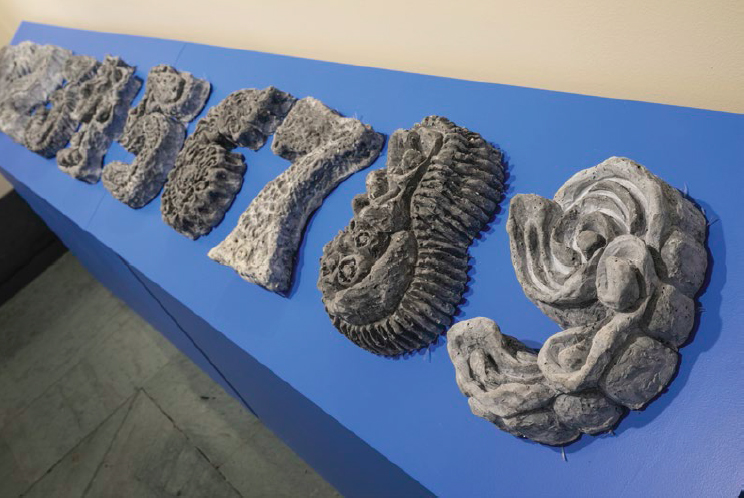
Viewers of this exhibition likely belong to the tertiary audience, experiencing documentation of rituals, workshops, and their outcomes. This does not imply that the exhibition is a collection of candid photographs taken haphazardly throughout Cortada’s career. Instead, the artist must envision how the work will translate from its initial presentation to its reception in documentation, often years apart. For The Underwater, Cortada crafted molds for the fabricating numbers (0-9) in sustainable concrete, with each sculpture weighing about 500 pounds (Figure 1). Workshop participants receive yard signs featuring a pre-printed arctic ice painting in blue and a marker to add the elevation of their home. Cortada creates aesthetic unity across the city where secondary and tertiary audiences (passersby) encounter the numbers set in cement as a serial project and reminder of sea level rise. The aesthetics employed by a socially engaged artist must contribute to the project like a map for posterity, communicating to the many viewers, across their diverse relationships to the work, not just the themes and commitments put forth, but how the piece was integrated with and shaped by the artist and their participants.
Cortada has spent more than thirty years engaging the public on issues of climate change, a scientific phenomenon that has become a political topic. Cortada’s climate actions meet the public in nebulous spaces where opinion and emotion combine with intellect. Thus, centering climate change as a creative idea for public participation is no small endeavor. The gestalt of his interactions transforms public spaces into artful messages for the yards, roadways, parks, schools, and intersections where people are reminded of sea rise levels and native tree species. His audiences become a part of the connective tissue between the facts of everyday life, and the climate crisis, and are nudged to reflect on and care for the environment. Artist Marc Chagall has famously said, “Great art picks up where nature ends.” In this exhibit, we might find instead how great art makes visible the boundaries where nature, as we know it today, will come to an end without further response and intervention.
xtine burrough is a media artist known for her work in digital poetry, social media interventions, artist books, and prints. As an arts educator, she documents her reflections and edits volumes of artists’ case studies to contribute to the field of artist writings. She has published with New Riders and Routledge and has a coauthored textbook forthcoming from MIT Press. She is a professor at UT Dallas, where she directs LabSynthE, a collaborative laboratory for the creative development of synthetic and electronic poetry.

