Preventing Technology Surprise: The Army's Leading-Edge Research Programs and the Subject-Matter Expertise That Fuels Them (2026)
Chapter: 3 Futures Thinking and Forecasting Technology Surprise
3
Futures Thinking and Forecasting Technology Surprise
INTRODUCTION
The word “futures” is used in the literal sense as a time still to come, and it is plural in recognition that multiple manifestations are possible. The future Army presumably must work with, and against, technologies that do not exist today. Therefore, “Army Futures” informally refers to the development and use of approaches to systematically and rigorously conceive, articulate, plan, and develop the Army of 2040.
However, since the future cannot be known with certainty, and plans are difficult to execute without specificity and precision, Army Futures attempts to provide futures forecasting that is solid enough to enable planning. Futures planning can bring a variety of benefits to the Army science and technology (S&T) community, the warfighter, and culture. Key observations from experts include the following:
- Creative thinking: Planning encourages innovative and new ideas in all levels of the organization.1
- Responsiveness: By envisioning a wide range of futures, an organization may be in a better position to respond to unexpected opportunities and unexpected actions by adversaries.2
- Confidence: By encouraging a wider range of scenarios, decision makers will be more comfortable handling a wide range of situations.3
- Decision quality: Studies show that scenario planning improves decision quality due to reducing biases, expanding previously held assumptions, changing mental models, and exchanging information between groups.4
- Reducing bias: Scenario planning has been proven to reduce multiple types of biases, including overconfidence, confirmation, and framing biases, which at times can hinder the path toward the right solution.5
___________________
1 S. Curin, B. Brooks, and O. Brooks, 2022, “Assessing the Influence of Individual Creativity, Perceptions of Group Decision-Making and Structured Techniques on the Quality of Scenario Planning,” Futures 144:103057.
2 P.J.H. Schoemaker, 1995, “Scenario Planning: A Tool for Strategic Thinking,” Sloan Management Review 36(2):25–40.
3 S. Curin, B. Brooks, and O. Brooks, 2022, “Assessing the Influence of Individual Creativity, Perceptions of Group Decision-Making and Structured Techniques on the Quality of Scenario Planning,” Futures 144:103057.
4 P. Meissner and T. Wulf, 2013, “Cognitive Benefits of Scenario Planning: Its Impact on Biases and Decision Quality,” Technological Forecasting and Social Change 80(4):801–814, https://doi.org/10.1016/j.techfore.2012.09.011.
5 P.J.H. Schoemaker, 1995, “Scenario Planning: A Tool for Strategic Thinking,” Sloan Management Review 36(2):25–40.
- Continuous learning: By embracing a culture of continual learning, organizations can remain agile, adapt to shifting environments, and make more informed decisions.
The committee found a vast number of formalisms and methodologies currently used by the Army for futures development, evaluation, and assessment. Broadly speaking, these constitute a set of tools that help to shape the Army fundamentally in all aspects. Unsurprisingly, the committee found that virtually none of these tools provide an output at the level of precision that can be fed by or feed into the S&T enterprise. This disconnect was widely acknowledged throughout the data gathering by committee and presenters alike. However, the committee found that Army presenters often held varying definitions of futures thinking, forecasting, exercising, wargaming, and experimentation processes. Of note, the heavy use of the term “wargaming” led the committee to perceive that many speakers believed wargaming to be the most important and impactful forecasting tool, when in fact wargaming is not technically a forecasting tool but rather a way of exploring how systems might respond to particular forecasted scenarios.
CURRENT ARMY FUTURES PRACTICES FOR THE SCIENCE AND TECHNOLOGY ENTERPRISE
Focused Excursions and Future Studies Program
The deputy director of the Army Research Laboratory (ARL) highlighted for the committee two programs currently run by Army Futures Command (AFC) to address futures in a manner that may interface with the S&T enterprise. The first was the Focused Excursions (FE) program, which is sponsored by the AFC Combat Capabilities Development Command (DEVCOM) and the Engineer Research and Development Center (ERDC). The second was the Futures Studies Program (FSP), which is in the Futures and Concepts Center (FCC) of AFC-DEVCOM. Both programs feed the development of “Army Concepts,” which describe how the Army of 2040 will operate, equip, and organize in an operating environment at that point in time. FEs are intended to deal with the S&T portion of the Army Concept, whereas the FSP is the mechanism by which the Army Concept is iteratively developed, assessed, and refined. FSP is an ongoing area of business for FCC whereas FEs are quarterly events that provide an opportunity for military personnel across divisions, including S&T leads, to conduct focused wargaming activities.
Although S&T leads can attend events held by the FSP, it is unclear how often this occurs, how broad or deep their participation is, and whether outcomes are measured. The committee also found the dissemination of the FSP reports are not generally accessible to the S&T community.6 In general, the FE program deals with questions of what could become a reality in 2040 and beyond. The general input signal into the FE program, however, is from FCC or senior commanders.7 By only receiving their inputs, the program misses the opportunity to engage the broader community and process of futures thinkers who could identify imaginative applications of emergent S&T ideas that could lead to surprise.
___________________
6 Panel discussion from LTC Thomas Arnold, Chief, Army FCC Disruptive Technology Branch, to Committee on Preventing Technology Surprise, March 6, 2025.
7 Panel discussion from Benjamin Wong, Focused Excursion Program Lead, ARL, to Committee on Preventing Technology Surprise, March 6, 2025.
The FE and FSP programs were initially created to serve as a mechanism for collaboration between warfighters and technical subject-matter experts and have evolved separately. In the FE program, administered by ARL, involves Army scientists and is meant to inform FSP, military members take part in wargame exercises. The participants of FSP are, in turn, meant to provide feedback to the scientists through FE. The committee observed the following inconsistencies in the two programs:
- FE and FSP are run out of separate supporting commands. Whereas FSP appears to be an ongoing business area for FCC, FE appears to be defined only at a project level within DEVCOM ARL, which makes buy-in from the broader S&T enterprise difficult.
- Classification levels, while potentially necessary, limit participation and dissemination to others in the workforce. Most of the FE meetings are held at the Controlled Unclassified Information (CUI) level, while the FSP is typically held at the SECRET level.
- The lack of scientific participation in FSP execution limits its ability to reflect the dynamic nature of technology innovation, hence limiting its ability to imagine the future.
- Both FE and FSP are limited to participation by Army personnel only. This precludes participation by members of industry and academia who could add invaluable expertise and insight.
- The exchanges between FE and FSP tend to occur in one direction—scenario inputs are typically provided by the FCC and senior commanders.8 This leaves little room for the S&T enterprise to work and discuss with military personnel the near-term capabilities as observed or studied by the enterprise.
- The outputs generated by FSP and FEs are not readily accessible by the wider S&T enterprise.9
A key to the success of forecasting efforts is diversity in the experience and fields of knowledge of the participants to generate “out-of-the-box” thinking.10 To improve the chances of preventing technology surprise, the Army should embed scientists, operators, and decision makers across planning, research, and scenario development.
Mad Scientist Initiative
The Mad Scientist Initiative, which is housed at the U.S. Army Training and Doctrine Command (TRADOC), is an initiative that explores the future operational environment and its implications for the Army. The initiative appears to be a thoughtfully structured effort that ensures substantial participation of key parts of the S&T expertise, military and civilian leadership, and appropriate stakeholders.
___________________
8 Ibid.
9 Panel discussion from LTC Thomas Arnold, Chief, Army FCC Disruptive Technology Branch, to Committee on Preventing Technology Surprise, March 6, 2025.
10 Panel discussion with Andy Hines (Program Coordinator, Houston Foresight), Cyndi Coon (Applied Futurist, Arizona State University), Brian David Johnson (Professor of Practice, Arizona State University), and Jonathan Moyer (Associate Professor, University of Denver) to Committee on Preventing Technology Surprise, March 5, 2025.
The Mad Scientist Initiative was established to address a finding of the 9/11 Commission that cited a lack of imagination as a vulnerability that led to that attack.11 Unlike the FE program, all of the work conducted by the Mad Scientists is releasable to the public and available through a variety of outlets, including YouTube, “the Convergence” Podcast, the Mad Sci Blog site, Twitter, and the Mad Scientist All Partners Access Network (APAN). By operating in the open, the Mad Scientist Initiative is able to develop a community of action comprised of government think tanks, academia, national laboratories, and the private sector. In this way, the Mad Scientist Initiative is apparently the only forecasting effort in the Army that brings together a diverse group of participants required to achieve effective forecasting.12
The committee noted that despite the current Mad Scientist Initiative being minimally staffed, it is able to generate thoughtful and imaginative future possibilities. In addition, while it operates at Distribution A, there currently is no pipeline to transition the scenarios or technologies identified by the initiative into real-world solutions.13 Interviews indicated that it has been difficult to introduce scenarios into other programs, such as wargaming, as wargames are typically closed systems.
Finding 3-1: No substantive evidence of integration between the Army’s S&T enterprise and its futures development efforts was found.
Not only have programs’ differing visions, execution, and organizational separation hindered effective coordination, but there appears to be no mechanism for Army Futures ideas to make their way to the S&T enterprise workforce, or for the S&T enterprise to contribute deliberately to the process, beyond shared alignments to high-level priorities. However, the committee notes that the home of the Mad Scientist Initiative, TRADOC, has recently been ordered to be combined with AFC.14 This provides a timely, ideal opportunity to strengthen the organizational ties between the three principal futures-thinking programs.
Recommendation 3-1: As the Army integrates the work of the U.S. Army Training and Doctrine Command and Army Futures Command, it should look for opportunities to link the inputs such as suggestions from scientists and operators and outputs such as the dissemination of final reports of the futures-focused programs in a more purposeful way.
___________________
11 Speaker presentation from Matthew Santaspirt, Deputy Director, Mad Scientist, to Committee on Preventing Technology Surprise, March 6, 2025.
12 Panel discussion with Andy Hines (Program Coordinator, Houston Foresight), Cyndi Coon (Applied Futurist, Arizona State University), Brian David Johnson (Professor of Practice, Arizona State University), and Jonathan Moyer (Associate Professor, University of Denver) to Committee on Preventing Technology Surprise, March 5, 2025.
13 Speaker presentation from Matthew Santaspirt, Deputy Director, Mad Scientist, to Committee on Preventing Technology Surprise, March 6, 2025.
14 Secretary of Defense, 2025, “Army Transformation and Acquisition Reform,” memorandum to Senior Pentagon Leadership, April 30, https://www.defense.gov.
OTHER ARMY ORGANIZATIONS AND PROCESSES INVOLVED IN FUTURE FORECASTING
Futures Thinking Attributes
Futures thinking methods—typically a set of methods constituted by horizon scanning, scenario planning, and threat/future casting—assist in the systematic ideation of possible realities. In Figure 3-1, there is an important distinction between “Futures Thinking” on the left side of the diagram and “Operational and Capability Assessment Methods” on the right. The operational and capability methods of validation and experimentation are essential for testing hypotheses. They confirm current assumptions, identify performance gaps, and improve readiness. But they operate largely within the context of understanding today’s systems and risks. On the other hand, these methods focus on exploration and imagination—exploring the outer bounds where tomorrow’s threats are likely to emerge, working synergistically to inform about threats, new technologies, and potential areas of surprise.
The U.S. Army has long recognized the value of planning to ensure the appropriate capabilities, personnel, and resources to meet potential national security challenges. The Army is not only recognized as an early adopter of scenario planning in particular, but it has been instrumental in the development and military application of scenario planning through its early work with RAND after World War II.
Peace-time plans are of no particular value, but peace-time planning is indispensable.
—Dwight D. Eisenhower, 195015
Timeframe
The “Houston Foresight Model” in Figure 3-1 refers to the “3 Horizon” methodology, which uses forecasting time horizons. The 3 Horizon methodology was developed by the management firm, McKinsey as a way for companies to manage current company performance while maximizing future growth opportunities.16 The committee found that it was the most universally applied model in the Department of War (DoW) (the Air Force and Army both use elements of it) and appreciates its simple way of categorizing and enumerating short-, mid-, and long-term timeframes. Designed as a practical approach to strategic foresight, the model integrates classic futures methods and systems thinking frameworks.17
Disciplined Process
Schoemaker defines futures thinking (he called it “scenario planning”) as a disciplined methodology, a structured approach that captures a full range of possibilities with detailed
___________________
15 J.F. Kennedy, 1962, “Remarks at the National Defense Executive Reserve Conference,” The American Presidency Project, November 14, https://www.presidency.ucsb.edu/documents/remarks-the-national-defense-executive-reserve-conference.
16 McKinsey & Company, 2009, “Enduring Ideas: The Three Horizons of Growth,” December 1, https://www.mckinsey.com/capabilities/strategy-and-corporate-finance/our-insights/enduring-ideas-the-three-horizons-of-growth.
17 A. Hines, J. Gary, C. Daheim, and L. van der Laan, 2017, “Building Foresight Capacity: Toward a Foresight Competency Model,” World Futures Review 9(1):5–20, https://doi.org/10.1177/1946756717715637.
information.18 Alexander Kott, the former Chief Scientist for ARL, stated that we can anticipate surprise if we do it regularly with disciplined brainstorming. He further stated that surprise is usually not about the technology but when and how the technology is deployed. To uncover those possibilities requires a systematic process that is exercised regularly, one that documents technology forecasts, assesses changes, and challenges.19
Broad-Based Participants and Stakeholders
Effective futures thinking is not based on predictions of past data or statistical inferences and is dependent on stakeholder discussions. It is a participatory process requiring active participation from internal and external stakeholders.
Andersen and colleagues describe its central purpose as a way to “open up the future, disclose a number of new possibilities, and avoid lock-in of perspectives focused on a single outcome.” This is regularly achieved by bringing in diverse and often unconventional views to extend the range of points of view brought to bear on a problem.20 Additionally, they expressed that when developing scenarios, it must be done in multi-stakeholder environments that include academics and technologists, potentially from different sectors to foster cross-functional discussions that open the aperture for creative, imaginative thinking.21
The Army has more than 40 senior research scientific and professional (ST) positions, all of whom have deep knowledge of recent advances and next-generation capabilities within their specialized areas. They serve in general-officer level positions, providing scientific and engineering advice to Army leadership and other U.S. agencies, such as the Defense Advanced Research Projects Agency and the National Aeronautics and Space Administration.22 Eleven of these positions are held within the ARL. The remainder are located within other downstream DEVCOM organizations.
Recommendation 3-2: Given the deep technical knowledge and executive-level influence of its senior research scientists, the Army should be empowered to play a stronger role in aligning futures with science and technology.
Scenario Creation
The development of scenarios/vignettes is a key and indispensable part of futures thinking. They are not intended to predict or forecast a unique, specific situation but rather to illustrate the range of possibilities, challenge the status quo, and to expand creative thinking. Krausmann describes that “scenarios are developed which do not describe the future to come, because it is variable and unknowable, but a set of possible futures that helps decision makers to
___________________
18 P.J.H. Schoemaker, 1995, “Scenario Planning: A Tool for Strategic Thinking,” Sloan Management Review 36(2):25–40.
19 Panel discussion from Alexander Kott, former Chief Scientist for ARL, to Committee on Preventing Technology Surprise, March 6, 2025.
20 P. Anderson, et al., 2021, “Stakeholder Inclusion in Scenario Planning: A Review of European Projects,” Technological Forecasting and Social Change 169:120802, https://doi.org/10.1016/j.techfore.2021.120802.
21 Panel discussion from Lance Mortlock, EY Canada Managing Partner, Industrials and Energy, to Committee on Preventing Technology Surprise, March 5, 2025.
22 U.S. Army, 2018, “Army Taps Researcher for Senior Science Position,” Army.mil, last updated September 5, https://www.army.mil/article/211166/army_taps_researcher_for_senior_science_position.
orient themselves in the maze of uncertainties they have to go through.23 Along similar lines, Schoemaker offers that scenario planning divides knowledge into two areas: (1) things we believe we know something about, which projects the past forward and includes aspects you are confident about, and (2) elements we consider uncertain or unknowable. Scenarios are designed to question existing beliefs and technical, economic, geopolitical, and social global views and frequently include elements that cannot be formally captured through regular forecasting methods.24
The scenarios most application to DoW use some degree of imagination to evoke a sense of urgency or immediacy to reflect capabilities that might be pursued in real life. They should be grounded in present-day context but presented in such a manner as to provoke the thinking required for conceptual understanding, future research opportunities, and ultimately, capabilities development.
Wargaming
Wargames are emulations of military conflicts used extensively by all branches of the military to prepare and evaluate their capabilities.
While wargaming seemed to be the most integrated activity across the Army population, the cost and complexity of these efforts lead them to primarily be used in the assessment of near-term technologies. In fact, multiple experts specifically indicated that traditional wargames and tabletop exercises are limited to near-term technologies, as the high level of uncertainty in forecasting exercises prevents effective wargaming in a traditional sense.
Sources of Inspiration
During the process of generating possible outcomes, a key component is allowing individuals free time to ideate and think outside of the box. Furthermore, to nurture the idea generation/innovation process, there should be an incentive structure to reward team members that engage in these activities. These could manifest themselves as either monetary or career advancement opportunities that incentivize conducting these exercises.
Science Fiction Prototyping Informing Vignettes and Scenarios
Popular culture, such as fictional novels and movies, can also provide important sources of inspiration for futures thinking methods. The number of potential possibilities is limited only by the creativity and imagination of the author. Science fiction prototyping can bridge the gap between known unknowns and unknown unknowns by stretching imagination beyond conventional boundaries while grounding stories in recognizable logic and context. It is important to note that these examples are selected with the benefit of hindsight, as there are many more science fiction technologies that have (at least so far) failed to materialize in the real world. Nevertheless, it is possible, and they should be considered as valid inputs. Some examples include the following:
___________________
23 E. Krausmann and A. Necci, 2021, “Thinking the Unthinkable: A Perspective on Natech Risks and Black Swans,” Safety Science 139:105255, https://doi.org/10.1016/j.ssci.2021.105255.
24 P.J.H. Schoemaker, 1995, “Scenario Planning: A Tool for Strategic Thinking,” Sloan Management Review 36(2):25–40.
- One of the earliest historical examples of military suggestions is Jules Verne’s 20,000 Leagues Under the Sea written in 1870, which presaged the advent of submarines along with their ability to destroy surface ships.25
- Isaac Asimov’s novel I, Robot, written in 1950, explored the theme of artificial intelligence capabilities and whether robotics could autonomously deliver lethal attacks on humans.26
- Robert Heinlein’s Starship Troopers, published in 1959, is another example. Its predicted, innovative concepts included exoskeletons, sensors monitoring soldier vital signs, and the use of tactical nuclear weapons. It also highlighted the need for high-speed, precise insertion of troops into combat zones.27
- In the 1977 James Bond movie The Spy Who Loved Me, the concept of an amphibious vehicle capable of launching missiles against enemy combatant threats was introduced.28
- In the 2005 “Flight of the Phoenix” episode of Battlestar Galactica, the concept of computer virus infections spreading through computer networks and disabling a connected modern fleet was introduced.29
- In 2012, the Army began work on its TALOS project, shorthand for Tactical Assault Light Operator Suit, which was intended to provide functions suggested by the 2008 Marvel movie Iron Man. It was cancelled in 2019 due to technical feasibility issues.
- In the 2013 movie Olympus Has Fallen, the concept of fully autonomous kamikaze lethal swarms using image recognition was introduced.30
- More recently, the 2022 novel 2034: A Novel About the Next World War by Elliot Ackerman and Admiral Stavridis, envisioned the ability to take over adversary aircraft by covertly embedding software switches within the millions of lines of code in modern combat vehicles.31
- Useful Friction is an active website and organization led by Peter Singer and August Cole, authors of Ghost Fleet, which collects and distributes strategic fictional narratives, many of which are intended to guide future military policies and work. Each story, written by team members drawn from a variety of different backgrounds, contains both facts and how they relate to human goals and experiences.32
INTEGRATING TALENT, TECHNOLOGY, AND LEADERSHIP
Futures thinking is in many ways similar to the scientific method. Both involve systematic observation, experimentation, inductive and deductive reasoning, and the formation and testing of hypotheses. However, S&T futures are not equivalent to Army Futures. Improving
___________________
25 J. Verne, 1870, Twenty Thousand Leagues Under the Sea, trans. L.P. Mercier, Geo. M. Smith & Co.
26 I. Asimov, 1950, I, Robot, Gnome Press.
27 R.A. Heinlein, 1987, Starship Troopers, Ace Books.
28 Eon Productions, 1977, “The Spy Who Loved Me,” 1977, directed by Lewis Gilbert, produced by Albert R. Broccoli.
29 Battlestar Galactica, 2005, “Flight of the Phoenix,” season 2, episode 9, directed by Michael Nankin, aired September 16, 2005, Sci-Fi Channel.
30 J. Holmes, 2021, “The Navy Can Learn from Star Trek and Battlestar Galactica,” The National Interest, August 31, https://nationalinterest.org/blog/reboot/navy-can-learn-startrek-and-battlestar-galactica-192769.
31 E. Ackerman and J.F. Stavridis, 2022, 2034: A Novel of the Next World War, Penguin Press.
32 Useful Fiction, n.d., “About Us,” https://useful-fiction.com/about-us.
the linkages between S&T and Army futures requires extraordinary communication and collaboration among the respective stakeholders.
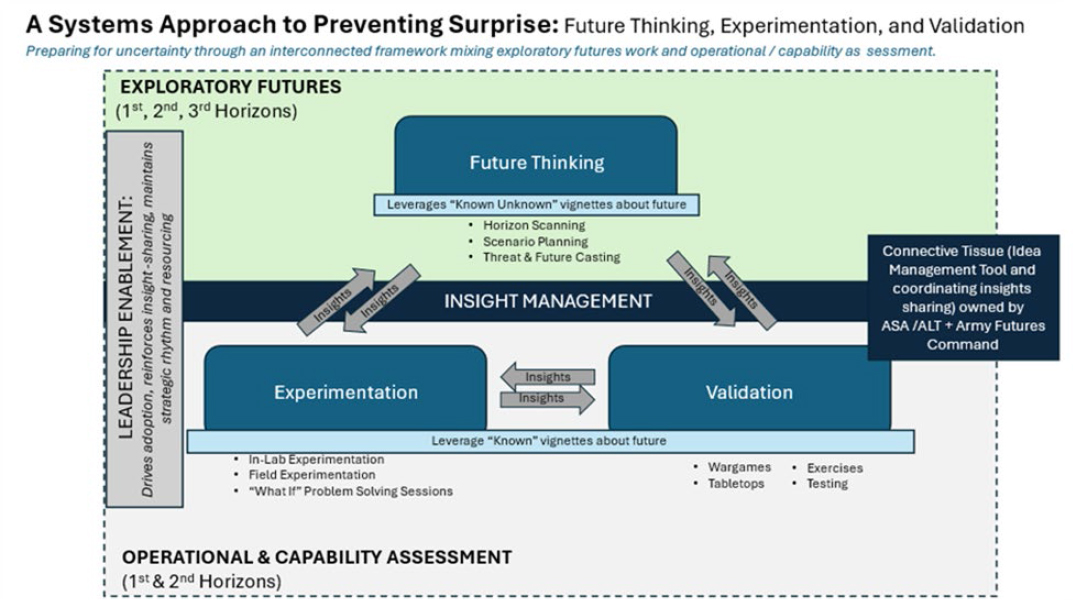
Recommendation 3-3: The Army should adopt a systems approach to linking results from Exploratory Futures and Operational Capability Assessments, so that emerging science and technology investment opportunities are readily available for consideration by leadership.
This section describes an approach where the three key elements from Figure 3-1—future thinking, experimentation, and validation—could work together to prevent or at least mitigate technology surprise. The graphic depicts the three elements, along with the specific methods for each, connected via “insight” arrows that symbolize cross-team and cross-silo collaboration.33 Key insights are captured via an “insight management” tool that would ensure that unique ideas born from these scanning efforts always receive due consideration and an opportunity to get to the bench through early incorporation into the Planning, Programming, Budgeting, and Execution (PPBES) process. This model is dynamic and includes feedback loops so that the ideas, imagination, and creativity of the participants (whether vignette writers, scenario planners, or anything in between) has a regular and repeatable opportunity to get those ideas into the deliberations of new Army concepts. It fosters all the attributes of an adaptable culture, including continuous exploration, capture of key insights, collective learning, and impactful collaboration. Most importantly, it ensures that these big ideas have early consideration in the PPBES process,
___________________
33 The ERPs and ARL are within the AFC command structure but are not typically engaged to a substantial degree in the development of Army futures.
ensuring the S&T community is not wedded to programmatic practicalities but instead to the big ideas that cross disciplines and are firmly in Horizon 3 timeframes.34
Implementation: Translating Ideas into Insight
Presenters to the committee described idea management tools as both the culture and the tools by which we capture ideas.35 The committee found that a solid culture largely mirrors the attributes already espoused in a resilient S&T enterprise. Therefore, in this context, the focus is on the value of digital platforms or software applications designed to facilitate the collection, evaluation, development, and implementation of ideas or insights within organizations.36 These tools support innovation, collaboration, and continuous improvement by enabling teams to share, discuss, and prioritize new ideas efficiently.
Most commercially available idea software solutions are designed to capture innovative ideas that can improve the organizations—an idea box. The committee proposes going a step beyond ideas to capture not only the ideas themselves but also insights that emerge from them. This is especially crucial due to the large number of disparate stakeholders. Capturing these insights not only strengthens the processes repeatability and improves employee engagement but is the critical step to ensuring that these ideas are regularly brought to the attention to leadership for early consideration in the PPBES process.
Recommendation 3-4: The Army should implement a solution that allows insights to be readily shared, accessed, and tracked by stakeholders so that good ideas are not left “on the cutting room floor.”
For the Army and DoW more broadly, there are several practical applications for formal, multi-organizational insight management. One key strategy is utilizing centralized insight capture to consolidate insights from soldiers, industry contractors, and branch researchers across diverse activities.37 Centralizing this information would enable the rapid dissemination of feedback and ideas from soldiers in the field to research laboratories, facilitating the swift development of new tools and technologies that meet operational needs. The committee notes that this is already commonly done within specific phases (such as the experimentation phase) but does not typically cross budget activity boundaries. Such an insight repository could also be the basis for scanning the landscape of current technological advancements in order to assess progress toward advanced technologies that may or may not be envisioned in the futures work, or that could signal a surprising new technology.
By crowdsourcing ideas and insight internally and employing evaluation and scoring tools to vet submissions, the Army could enhance its agility in adapting to the rapidly evolving technological landscape and emerging threats. Furthermore, if not already implemented, establishing documentation protocols for previous projects or prospectuses—with detailed
___________________
34 The timeframe for Horizon 3 is between 5–15 years.
35 Panel discussion from Elizabeth Roll, Fellow, Sandia National Laboratories, to Committee on Preventing Technology Surprise, March 5, 2025.
36 D. Zhu, A. Al Mahmud, and W. Liu, 2023, “A Taxonomy of Idea Management Tools for Supporting Front-End Innovation,” Applied Sciences 13(6):3570, https://doi.org/10.3390/app13063570.
37 D.J. Leach, C.B. Stride, and S.J. Wood, 2006, “The Effectiveness of Idea Capture Schemes,” International Journal of Innovation Management 10(3):325–350.
explanations and contextual analysis of results and outcomes—would support institutional learning and continuous improvement.


