Long Freight Trains: Ensuring Safe Operations, Mitigating Adverse Impacts (2024)
Chapter: 5 Impacts on the Public
5
Impacts on the Public
This chapter considers whether long trains may be adversely impacting the public by occupying highway-rail grade crossings more often or for longer periods and by contributing to delays of Amtrak passenger trains. Highly relevant to both kinds of impacts is whether the rail infrastructure is able to accommodate longer trains. The first part of the chapter considers how long trains can affect the functioning of grade crossings and how chronic blocked crossings can be problematic for affected communities. The second part of the chapter considers how long trains can affect the operation of the passenger trains operated by Amtrak, which is legally afforded dispatching preference when using the track of host freight railroads.
HIGHWAY-RAIL GRADE CROSSINGS
Highway-rail grade crossings are locations where roadways and rail lines intersect at the same “grade” or level. At these grade crossings, a traveler on the road can be delayed by, or even collide with, a train. When the train, moving or stopped, occupies the crossing, road travel cannot—or should not—take place and the crossing is considered blocked. There are currently more than 212,000 highway-rail grade crossings on approximately 140,000 route-miles of track in the U.S. railroad system.1
The consequences of blocked grade crossings for communities vary depending on factors related to rail operations, the community’s road
___________________
1 FRA (Federal Railroad Administration). 2024. All States Crossing Data. https://safetydata.fra.dot.gov/OfficeofSafety/publicsite/DownloadCrossingInventoryData.aspx.
system, and the location of critical land uses. Rail operation factors include the frequency and duration of blocked crossings, as well as time of day. For example, three blocked crossing events during 3:00 p.m. to 5:00 p.m. on a weekday will have different impacts than the same three events that take place between 8:00 p.m. and 6:00 a.m. during the weekend. Across communities, the consequences of blocked grade crossings will differ depending on such factors as the availability of alternative routes for motor vehicles and pedestrians, the lengths of the detours, and the impacts of any resulting vehicle congestion. The consequences of delayed or rerouted road travel also vary. Trips for which time is of the essence, such as emergency services, have high consequences, as do trips that are time dependent, such as arriving on time for school, work, or a medical appointment. Blocked crossings may also induce risky behaviors, such as drivers trying to “beat the train” or people on foot crawling over or under a stopped train at considerable personal risk.
Train Length and Blocked Crossings
It is possible that longer trains result in fewer trains and therefore fewer blocked crossing events in the rail network overall and in specific communities.2 However, the duration of each blocked crossing event will increase, because it takes the longer train more time to pass through the crossing. Apart from the logical inference that a long train will take more time than a short train to transit a grade crossing simply because of its added length, the evidence to suggest that long trains block grade crossings more often, whether idle or moving, is largely anecdotal. Nevertheless, as the length of time any particular crossing is blocked increases, the number of complaints about it increases significantly. The committee heard from leaders of communities impacted by chronic grade crossing blockages who maintain that train length is a factor in both the frequency and duration of blockages. The relationship between community impacts and the frequency versus duration of blocked crossing events still requires research.
For a given number of rail cars distributed in a fewer number of long trains versus a greater number of shorter trains, it is not clear whether the total duration of blocked crossing events favors the long trains. Because the duration of a blocked crossing event includes the time it takes for the gates to lower and raise, which is a fixed interval per train, fewer gate cycles would slightly reduce the total duration of blocked crossings. However, in many situations, long trains do not run at the same average speed as shorter trains. Rail lines have speed restrictions (such as for curves, bridges,
___________________
2 This is the hypothesis of several railroads and the Association of American Railroads (AAR), as presented to the committee.
traveling in urban areas, track maintenance crews, etc.) where trains are required to slow down to pass through the point or area. For a given point, a 1-mile-long train traveling at a speed-restricted 20 mph would require a minimum of 1/20 of an hour, or 3 minutes, for its entire train to pass a given point. A 2-mile-long train would require a minimum of 2/20 of an hour, or 6 minutes, for its entire train to pass the same given point at 20 mph. This means that the 1-mile-long train must slow its travel to 20 mph for 3 minutes, but the 2-mile-long train must travel at 20 mph for 6 minutes before both trains can accelerate to normal speed.3
In addition, as the long train passes through a community with numerous grade crossings, it is more likely to simultaneously block multiple crossings, and therefore potentially disrupt road travel patterns more severely for a longer period of time than for the same number of cars in shorter trains.4
For long trains that must stop, there will be fewer locations where they can be stopped without blocking crossings. Long trains may be stopped and blocking crossings—or cause other trains to be stopped and blocking crossings—because they are waiting for a meet with another train, being held out of yards, or running out of time under the crew’s maximum hours of service.5,6
If a blocked crossing is unavoidable, the practice had been to “cut” the train, which involves breaking the connection between rail cars and moving a section of the train to open a gap at the crossing, which then allows vehicle and pedestrian travel. The longer the train, the more difficult cutting the train becomes. It may be more time consuming for the crew to walk the long train to reach the crossing to disassemble the train and then return later to put it back together. It will also take longer to restore the train’s air brakes (see Chapter 3) to prepare for departure, lengthening the time the fully reassembled train is again blocking the crossing. For long trains stopped at crossings, the practice of cutting may become impractical.
Yard Constraints and Blocked Crossings
Representatives from the railroad labor unions who briefed the committee indicated that their members have observed long train operations resulting in blocked highway-rail grade crossings, especially in urban areas and near large rail yards.7 In particular, they have observed that assembling blocks of
___________________
3 Stephens, B. 2023. “The Shortsighted View of Long Trains.” Trains 83:8. https://www.trains.com/wp-content/uploads/2022/12/MAG-TRN-FEB23.pdf.
4 Reports from local officials from Bensenville, Illinois, and Bushnell, Illinois, June 2023.
5 Stephens, B. 2023. “The Shortsighted View of Long Trains.” Trains 83:8. https://www.trains.com/wp-content/uploads/2022/12/MAG-TRN-FEB23.pdf.
6 BLE-T presentation to committee, January 2023.
7 American Train Dispatchers Association (ATDA) presentation to committee, January 2023.
cars prior to departure and distributing blocks of cars upon arrival is leading to trains extended outside of yards, which can block nearby crossings.8 For example, when a yard does not have tracks long enough to hold a train that is being assembled or disassembled, the train may extend out onto the mainline, potentially blocking rail traffic and highway-rail grade crossings for extended periods.9 This is more likely to be the case where the rail yards that assemble and disassemble manifest trains are many decades old and were not designed to accommodate long trains. Such a situation can lead to yard congestion, delays of freight trains in the vicinity of the yard, and blocked highway-rail grade crossings from waiting trains and from trains spilling out onto tracks outside the yard.10 While the focus of this section is on how these yard constraints can affect blocked crossings and the public, Box 5-1 discusses the potential for adverse impacts on freight train operational fluidity and the railroads’ shipper customers.
Under Precision Scheduled Railroading (PSR), Class I railroads decreased reliance on their networks of hump classification yards to sort cars.11 In 2017, CSX reduced the number of hump yards it operated by either closing them or converting them to flat switching facilities.12 Other Class I railroads have followed suit, with the number of active hump yards in the United States decreasing from 57 in 1996 to 35 in 2018.13 A result of this trend is increased use intensity of the remaining hump yards and increased manifest train size due to the concentration of more activity in fewer yards.
The building of long trains at originating yards can tie up the yard by blocking the switching lead (and sometimes the mainline) for longer periods of time due to the increased size of trains, a problem recognized by the railroads who devote significant amounts of their network capacity investments toward siding extensions, new longer sidings, and overall yard expansions.14 The lack of sufficiently long departure tracks exacerbates the situation for many yards with track lengths designed for considerably
___________________
8 BLET (Brotherhood of Locomotive Engineers and Trainmen), SMART (Sheet Metal, Air, Rail and Transportation), and ATDA.
9 SMART presentation to committee, January 2023.
10 ATDA presentation to committee, January 2023.
11 A hump yard is a facility that utilizes gravity, usually a hill, to more efficiently reorganize and assemble rail cars. For an example, see https://www.bnsf.com/news-media/railtalk/service/hump-yards.html.
12 Stephens, B. 2017. “CSX Hump Yards Are Targets.” Trains 77:8.
13 Zhao, J., and C.T. Dick. 2022. “Quantitative Derailment Rate Comparison of Unit Trains at Transload Terminals and Manifest Trains at Railroad Switching and Hump Classification Yards.” Transportation Research Record 2677(1):311–325. https://doi.org/10.1177/03611981221099287.
14 CPKC presentation to committee, April 2023; Harwell, J.A. 2023. “CPKC’s Shreveport Dilemma.” Trains 83:14–23.
BOX 5-1
Short and Long Train Impacts on Shippers of Rail Freight
Yard-related issues have the potential to affect the quality of service provided to freight rail shippers. Because longer trains take more time to process, switch, assemble, and inspect at a classification yard, longer minimum connection times between arriving and departing trains must be planned at each classification yard in the rail car trip plan. This extra yard connection time may extend the average origin-to-destination transit time of freight shipments through the network. In addition, because they transport more freight at once, longer trains may necessitate reduced departure frequencies in order for a sufficient “train load” of freight to accumulate for a given destination or departure block. Reduced departure frequencies of longer trains increase the average rail car waiting time in classification yards, further extending rail car transit times in the network and potentially diminishing the level of service provided to freight shippers.
Multiple studies have demonstrated the service and rail car transit time benefits of operating more frequent, shorter trains that connect a greater number of origin-destination terminals with direct service, as opposed to a smaller number of longer trains between a limited set of terminals.a,b The result was that each type of traffic departed each yard for a given destination multiple times per day, greatly reducing yard dwell and decreasing rail car transit time while still accruing the economic and efficiency benefits of longer trainsc During the implementation of PSR, railroads operated longer trains between two or more major concentration or distribution points (i.e., rail yards and terminals), as opposed to trains used for local services or unit trains) One of the disadvantages of PSR from a customer service standpoint is that it reduced the possibilities to forward traffic more expeditiously, rather than having it wait for a single ride. The service benefit of short train operations has largely been lost as current long train operating strategies place more emphasis on increasing train length for single types of traffic, and less on train and blocking plans that leverage long trains to generate multiple departures per day between each pair of yards. These are decisions railroads must make and work out with their paying customers.
__________________
a Leilich, R.H. 1974. Study of the Economics of Short Trains. Washington, DC: Peat, Marwick, Mitchell & Co.
b Diaz de Rivera, A., C.T. Dick, and M.M. Parkes. 2021. “Balancing the Service Benefits and Mainline Delay Disbenefits of Operating Shorter Freight Trains.” Transportation Research Record 2675(10):303–316. https://doi.org/10.1177/03611981211011484.
c Dick, C.T. 2021. “Precision Scheduled Railroading and the Need for Improved Estimates of Yard Capacity and Performance Considering Traffic Complexity.” Transportation Research Record 2675(10):411–424. https://doi.org/10.1177/03611981211011486.
shorter trains.15,16 The situation may be repeated at destination yards due to the increased difficulty of receiving longer trains that exceed the length of receiving tracks. Operating longer trains often requires outbound crews to combine several trains together from tracks that used to fit entire shorter trains. Inbound trains are often required to switch blocks of cars to several tracks for the same reason. The additional effort to dispatch and receive long trains can consume a disproportionate amount of time, blocking yard leads and sometimes mainline track.17 For these reasons, other yard operations are often affected or delayed as long trains are dispatched or received.18
Chief among these effects is decreased dependability of industrial switching because yard resources have been reduced to increase efficiency and remaining resources may be committed to handling inbound and outbound trains before first mile and last mile movements can be addressed. Furthermore, the elimination of some major classification yards caused a lot of rail car sorting work to be shifted to smaller local and industrial yards where crews now spend more time pre-blocking outbound rail cars for different network destinations instead of preparing local trains or servicing nearby rail customers.19 Additional long train impacts on shippers are described in Box 5-1.
Information on Blocked Crossings
The committee was told by Class I railroads that they monitor grade crossings as part of their overall freight train operations and safety. Railroads have dashboards depicting the location and number of blocked crossings by city, state, time of day, and time of week to help dispatchers monitor blocked crossings and monitor and assess community concerns. One railroad reported that it has recently added crossing locations to dispatcher dashboards in addition to dashboards at control centers.20 Another railroad reported that, based on its monitoring, it has not found any correlation
___________________
15 SMART presentation to committee, January 2023.
16 Stephens, B. 2023. “The Shortsighted View of Long Trains.” Trains 83:8. https://www.trains.com/wp-content/uploads/2022/12/MAG-TRN-FEB23.pdf.
17 Time spent arriving and departing is also increased due to requirements of trains to obey yard and other speed restrictions for the entire train.
18 ATDA presentation to committee, January 2023.
19 Dick, C.T. 2021. “Precision Scheduled Railroading and the Need for Improved Estimates of Yard Capacity and Performance Considering Traffic Complexity.” Transportation Research Record 2675(10):411–424. https://doi.org/10.1177/03611981211011486.
20 CSX presentation to committee, March 2023.
between train length, the duration of blocked crossings, and the quantity of blocked crossing notifications they receive.21
To analyze the impacts of long trains on the functioning of highway-rail grade crossings, the committee posed two questions:
- Are the community impacts related to blocked crossings increasing?
- Are long trains responsible for any increased impacts?
On the first question, the qualitative information and limited quantitative data that are discussed in more detail below indicate that chronically blocked crossings are a problem in some communities. On the second question, long trains appear to be a factor in some locations experiencing chronic crossing problems. The quantitative data required to definitively answer both questions, however, are not publicly available.
FRA Data
Public data on the extent of blocked crossings in the United States are limited, and much of what exists is qualitative or not suitable for quantitative analyses. Even if suitable data on the extent of blocked crossings existed, causal analysis would also require appropriate data on train length. During the course of this study, the Federal Railroad Administration (FRA) began requiring Class I railroads to report train length in accident reports, starting in 2023.
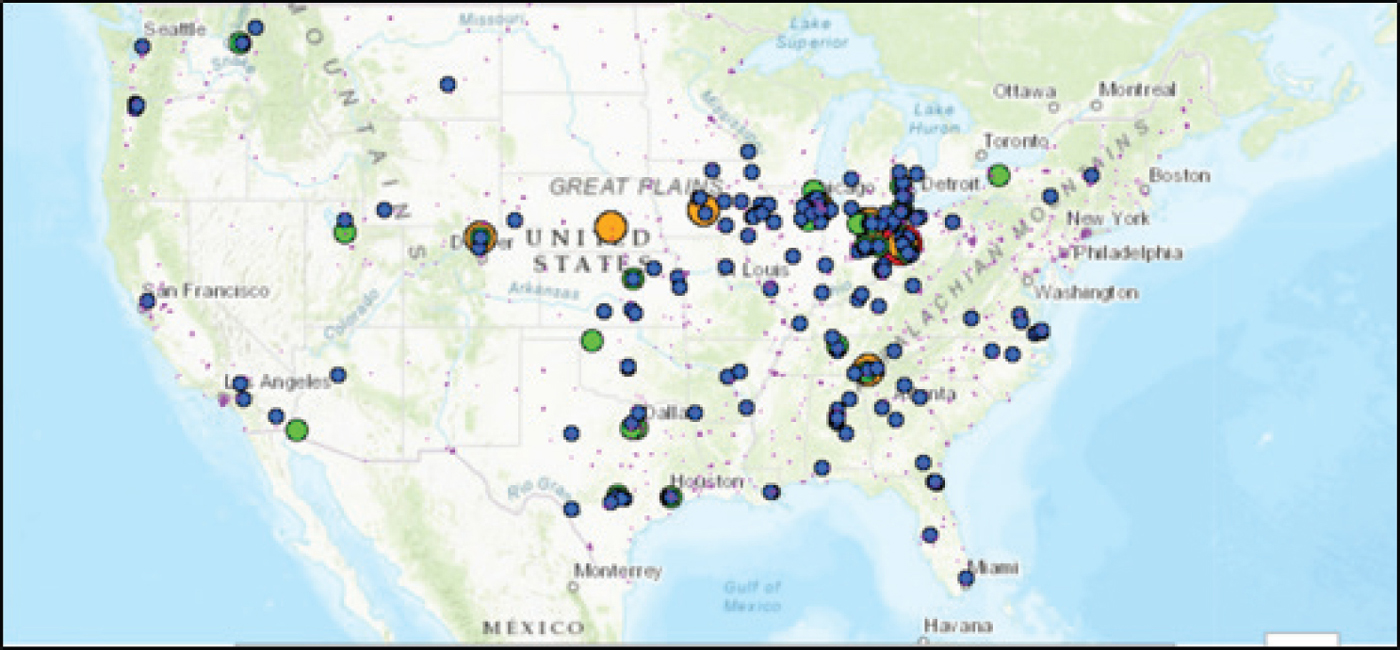
FRA has been collecting crowd-sourced information on blocked crossings since 2019. Since then, more than 91,800 blocked crossing incidents have been identified by members of the public, including the reported date, time, and duration of the reported blocked crossings. The information has been reported in all 50 states, with the highest number of incidents in Texas, Ohio, and Illinois. Figure 5-1 illustrates reported incidents across the nation. Among the limits of this database is that the results may be skewed for various reasons, such as geographic variability in and public knowledge of the reporting system. In addition, there is no process for correlating the reports with train length.
Sensor Data
Proprietary acoustical sensors can capture the date, time, and duration of blocked crossings and other information. To date, approximately 150 jurisdictions in North America have employed such sensors to alert first responders and motorists regarding blocked crossings and to provide data
___________________
21 Union Pacific Railway presentation to committee, March 2023.
SOURCE: FRA. “Public Blocked Crossing Incident Reporter.” https://www.fra.dot.gov/blockedcrossings/incidents (accessed May 31, 2024).
to support applications for government funding of grade crossing improvements or removals.
A consultant was retained as part of this study to gain a better understanding of how sensor technology could be used to identify and assess blocked crossings, including for monitoring blockage times. The study area included three highway-rail grade crossings in Jacksonville, Florida, and seven in Houston, Texas.22 The locations were selected based on proximity to rail yards at which manifest trains are assembled and dissembled. Between June 1 and August 31, 2023, the sensors used by the consultant recorded 3,440 events at three crossings in Jacksonville, 6% of which were longer than 10 minutes. During the same time period, sensors recorded 11,700 blocked crossing events in Houston, 20% of which were longer than 10 minutes. An event is defined as when a moving or stationary train blocks a crossing for a period of time.23
While these results confirm that lengthy blocked crossings can indeed be problematic in some locations, the effects of longer trains could not be determined. Data limitations from this detection source include unknown train type, unknown presence of distributed power locomotives, and limited data on train speed and train length.
___________________
22 Florida Department of Transportation and the City of Houston allowed the committee to view data from these locations in support of this study.
23 TRAINFO, presentation to committee, November 2023.
Community Impacts
In the absence of quantitative data, the committee sought to gauge the significance of the community impacts from blocked crossings by consulting media reports and meeting with affected communities.
The committee heard from leaders of communities impacted by chronic grade-crossing blockages who maintain that train length is a factor in both the frequency and duration of blockages. Some of the communities are in proximity to rail yards where trains frequently stand idle for long periods waiting for entry into the yard, and where train assembly and disassembly operations can lead to trains moving back and forth over one or more crossings multiple times. As the length of time any particular crossing is blocked increases, the number of complaints about it increases exponentially. The community leaders complained about the resulting increased response time for emergency responders and the lengthy and recurrent delays incurred by motorists and pedestrians. Examples of interrupted access to neighborhoods, schools, and recreational facilities were given along with instances where impeded pedestrians, including students, maneuvered through stopped trains at considerable personal risk. These consultations suggest that, as might be expected, the impacts on emergency response times raise some of the most significant public interest concerns due to their safety ramifications. Fire trucks, ambulances, and police vehicles that are rerouted because of a blocked crossing or delayed by the ensuing traffic congestion can be a matter of life or death. Deploying duplicative emergency response assets so neighborhoods do not get isolated by blocked crossings is expensive.
The following are specific examples of disruption related to blocked crossings from communities in Illinois, Indiana, and Maryland.
Barrington, Illinois
The Mayor of the City of Barrington, Illinois, described blocked crossings that created delays for emergency responders that have lasted hours.24
Bensenville, Illinois
The Village Manager of Bensenville described persistent blocked crossings (at York Road, Center Street, Addison Street, and Church Street) because of a Class I railroad’s yard operations. The official maintained that long trains are blocking more crossings concurrently, making it more difficult for drivers to find an alternate route.25 The fire chief described impacts
___________________
24 Mayor of Barrington, Illinois, June 15, 2023.
25 Local officials from Bensenville, Illinois, June 16, 2023.
of long train operations, including the need to build a second fire station to improve response times. Today, because there are fire stations on both sides of the tracks, fire truck response times using York Road are less than 4 minutes, but previously, with a fire station on only one side of the tracks, blocked crossings forced fire trucks to use Route 83, which delayed units by 8 to 12 minutes.26
Bensenville is part of the Coalition of Nine Communities Opposed to the CPKC Merger that has documented the increased freight rail traffic and related impacts. Railroad actions in one community can spill into another. Several crossings in Franklin Park, Illinois, are routinely blocked when assembling or disassembling trains in the Canadian Pacific Kansas City Railway (CPKC) yard at Bensenville.27 This is corroborated by cameras installed by local officials. In response to the coalition’s concerns, the Surface Transportation Board (STB) required CPKC to report grade-crossing blockages caused by increased traffic associated with the merger, including in the Chicago area. To date, CPKC has reported no blockages in the area of Bensenville. However, this appears to be due to CPKC’s reporting method, which excludes these tracks because they are used by CPKC trains but owned by Metra, the commuter rail agency. CPKC has not been reporting blockages on rail lines it does not own.28
Hammond, Indiana
In Hammond, Indiana, video recordings of students climbing between and under stopped freight rail cars to get to school garnered national attention. The trains, which can stretch across five or six intersections at a time in the working-class suburb of 77,000, routinely blocked the paths of students and teachers going to and from school.29 After the media attention in April 2023, Norfolk Southern took action to address the situation,30 but such actions proved to be temporary.31
___________________
26 Fire Chief, Village of Bensenville, Illinois, June 16, 2023.
27 Local officials from Bensenville, June 2023.
28 Provisions in the CPKC merger include documenting blocked crossings and assigning a community liaison to facilitate communication between CPKC and Chicago Area Officials and members of the public.
29 Sanders, T., et al. 2023. “As Rail Profits Soar, Blocked Crossings Force Kids to Crawl Under Trains to Get to School.” Propublica, April 26. https://www.propublica.org/article/trains-crossing-blocked-kids-norfolk-southern.
30 Sanders, T. 2023. “How Norfolk Sourthern Is Addressing Blocked Train Crissings in Hammond, Indiana.” Propublica, August 25. https://www.propublica.org/article/how-norfolk-southern-is-addressing-blocked-train-crossings-hammond-indiana.
31 Sterman, J., S. Smith, and T. Sanders. 2023. “New Video of Child Jumping from Moving Train Puts Spotlight Back on Blocked Crossings.” WTOC, December 12. https://www.wtoc.com/2023/12/12/new-video-child-jumping-moving-train-puts-spotlight-back-blocked-crossings.
New Berlin, Illinois
Railroads position trains awaiting room in a rail yard, blocking travel in the entire town, sometimes for hours.32 A business owner described how long trains parked at his private crossing, sometimes for days, have delayed shipments and prevented patrons from accessing his family business.33
East Dubuque, Illinois
Train operations have blocked numerous crossings for extended periods. This has affected farmers transporting loads of produce. In particular, trains blocking the one road into the Frentress Lake area prevent people from leaving to get to their jobs or entering to open their businesses, and people have missed doctor appointments. In addition, the blocked crossing can cause a backup of vehicles all the way through the exit ramp and onto Highway 20, a major arterial. During a recent blockage, people crawled over a coupling and under a rail car. The issues stemmed from operational issues between Canadian National Railway (CN) and Burlington Northern Santa Fe Railway (BNSF).34
Brunswick, Maryland
In Brunswick, Maryland, a major Class I rail yard sits between the city and the Potomac River. The blocked crossing due to long train yard operations has delayed commuters from accessing the MARC commuter train park-and-ride lot, people in vehicles and on foot from accessing the river park, and trucks from accessing a lumber yard.35 The geography of the town makes grade separation impossible, and the railroad and local officials are still discussing a solution.
Federal Oversight
The federal government has long recognized its responsibility for ensuring safety at highway-rail grade crossings through funding infrastructure improvements and requiring states to develop grade-crossing safety plans. Fatalities and injuries at highway-rail grade crossings have reduced
___________________
32 The committee heard from local officials and farmers whose communities and businesses were impacted by blocked public and private crossings (New Berlin, Illinois, and East Dubuque, Iowa).
33 Doug Danenberger, Danenberger Family Vineyard, New Berlin, Illinois, June 14, 2023.
34 Don Zillig, Jo Daviess County Councilor, East Dubuque, Illinois, June 14, 2023.
35 Julie Martorana, City Administrator, City of Brunswick, Maryland, May 2023.
approximately 60% from 425 fatalities in 2000 to 247 in 2023.36 However, the federal government has not exercised its authority to enforce blocked crossings.
Historically, federal investments in grade crossings have focused almost exclusively on improving safety by reducing vehicle-train crashes and related fatalities and injuries. The Federal-Aid Road Act of 1916 provided federal funds to states for the construction of rural post roads.37 Although federal aid funds could be spent on highway-rail grade crossings, early development of grade separations and active crossing warning devices were shared by the public sector and the railroads.38 Federal programs dedicated to grade-crossing safety began in 1935, and Congress authorized the first categorical funding program for crossing safety improvements in the 1973 Highway Act, with subsequent programs in 1978 and 1982 surface transportation authorizations. The Surface Transportation Assistance Act of 1987 established a federal grade-crossing safety program permanently in statute.39
States use federal grade-crossing safety funds to add passive and active grade-crossing warning devices to grade crossings using risk-based allocation formulas and models. Federal and state grade-crossing improvement projects take place on railroad right of way through agreements with applicable railroads, and railroads are generally responsible for maintenance of active crossing devices.
The U.S. Department of Transportation produced a Grade Crossing Safety Action Plan in 1994. A 2004 audit of the plan’s results, requested by a member of Congress, found that “some states continued to have a large number of public grade crossing accidents” and recommended that the seven identified states “should develop an action plan that identifies specific solutions for improving safety at those crossings that continue to have accidents.”40 Subsequently, the Rail Safety Improvement Act of 2008 (RSIA) required that the 10 states with the highest number of grade-crossing collisions over a 3-year period prepare State Action Plans to “identify specific solutions for improving safety at crossings, including highway-railway grade crossing closures or grade separations; focus on crossings that have
___________________
36 Operation Lifesaver. n.d. “Collisions & Casualties by Year.” Updated June 6, 2024. https://oli.org/track-statistics/collisions-casualties-year.
37 Appendix A in Highway-Rail Grade Crossing Handbook, 3rd Edition. FHWA Report FHWA-SA-18-040, FRA Report FRA-RRS-18-001, July 2019, p. 181.
38 Ibid, p. 179.
39 23 U.S.C. § 130. Railway-Highway Crossing. https://www.law.cornell.edu/uscode/text/23/130.
40 U.S. Department of Transportation. 2004. “Report on the Audit of the Highway-Rail Grade Crossing Safety Program.” Office of Inspector General Report No. MH-2004-065, June 16. https://www4.oig.dot.gov/sites/default/files/mh2004065.pdf.
experienced multiple accidents or that were at high risk for such accidents; and cover a period of five years.”41
In 2012, the National Transportation Safety Board (NTSB) recommended that the Federal Highway Administration (FHWA) and FRA develop a model grade-crossing action plan as a resource for states interested in producing an action plan similar to those required for the 10 states in the RSIA.42 FRA and FHWA jointly developed the Noteworthy Practices Guide: Highway-Railway Grade Crossing Action Plan and Project Prioritization in 2016 to provide guidance for states to prepare highway-rail grade crossing state action plans. In 2015, the Fixing America’s Surface Transportation Act required the remaining 40 states and the District of Columbia to develop state action plans.43 The Infrastructure Investment and Jobs Act (2021) added the Railroad Grade Crossing Elimination Program, which is providing more than $500 million annually for 5 years in discretionary grant funding for eliminating grade crossings and providing grade separations. The first round of grants issued in June 2023 for fiscal year 2022 totaled more than $570 million to projects in 32 states.44
Limits on State and Local Interventions
Railroad operations that cause trains, moving or stopped, to occupy or block highway-rail grade crossings had been the subject of state and local regulation, but not federal oversight. However, recent court rulings have reaffirmed that only the federal government has oversight authority over blocked crossings.
In the past, state and local governments had the power to force or incentivize railroads to alter their operations or provide infrastructure to remedy blocked crossings. An example from the late 19th and early 20th centuries: many cities were able to require rail-roadway grade separations, paid for in part or entirely by the railroads.45 In addition, many states had laws limiting the time that grade crossings could be blocked to
___________________
41 P.L. 110-432, Rail Safety Improvement Act of 2008, October 16, 2008. https://railroads.dot.gov/elibrary/public-law-110-432-rail-safety-improvement-act-2008.
42 NTSB (National Transportation Safety Board). 2012. “Highway–Railroad Grade Crossing Collision, US Highway 95, Miriam, Nevada, June 24, 2011.” Highway Accident Report NTSB/HAR-12/03, December 11. https://www.ntsb.gov/investigations/AccidentReports/Reports/HAR1203.pdf.
43 FRA’s State Highway-Rail Grade Crossing Action Plan (SAP) regulations can be found in 49 C.F.R. § 234.11.
44 FRA. n.d. “Railroad Crossing Elimination Grant Program.” Updated April 10, 2024. https://railroads.dot.gov/grants-loans/railroad-crossing-elimination-grant-program.
45 Sennstrom, B.H. 2001. Erie Lackawanna West End: Volume 1. Avoca, NY: Erie Lackawanna Historical Society.
20 minutes,46 and some states limited maximum blocked crossing time to 10 minutes.47 Many local communities fined railroads for blocking road crossings according to specified lengths of time.48
Highway-rail grade crossings exist at the intersection of two different regulatory regimes. Passage of the Federal Railroad Safety Act of 1970 (FRSA) and the Interstate Commerce Commission Termination Act of 1995 (ICCTA) reaffirmed federal primacy over railroad regulation, which is based on the federal government’s constitutional authority over interstate commerce.49 Notably, The ICCTA applied to only railroad economic regulation rates, not to safety. Authority to regulate roadways, for the most part, belongs to state governments. Jurisdiction over most aspects of highway-rail grade crossings also falls with the states.50 However, the courts have sided with the rail industry on blocked crossings and assigned authority to the federal government.51
Exclusive federal authority to regulate blocked crossings has been recently affirmed in State of Ohio v. CSX Transportation, Inc. The Ohio Revised Code states that no railroad may block a public street, road, or highway for longer than 5 minutes.52 In 2018, CSX was charged with crossing blockage violations associated with moving trains in and out of the Honda auto plant near Marysville, Ohio. CSX contended that the FRSA and the ICCTA preempted Ohio law.53 In 2022, the Ohio Supreme Court agreed with CSX and ruled that “the regulation of railroad transportation
___________________
46 McEowen, R.A. 2016. “How Long Can a Train Block a Crossing?” Agricultural Law and Taxation BLOG. LPB Network. https://lawprofessors.typepad.com/agriculturallaw/2018/11/how-long-can-a-train-block-a-crossing.html.
47 Iowa Department of Transportation. 2023. “Railroad Rights-of-Way, Crossings, Tracks, and Fencing.” § 327G.32. https://www.legis.iowa.gov/docs/ico/chapter/327G.32.pdf; Iowa & Nebraska Legislature. “Railroads; Blocking Crossings; Penalty.” 17-225. https://nebraskalegislature.gov/laws/statutes.php?statute=17-225.
48 Slaughter, K. 2005. “Runaway Train? Federal Preemption of State and Local Laws.” University of Minnesota. https://conservancy.umn.edu/server/api/core/bitstreams/42a0f0de-cd7e-403e-81e1-b6106da0361f/content.
49 Ibid.
50 Within some states, responsibility of highway-rail crossings is divided between several public agencies. In other states, jurisdiction over highway-rail grade crossings is assigned to a regulatory agency such as the public utility commission, public service commission, or state corporation commission. FRA. 2021. Compilation of State Laws and Regulations Affecting Highway-Rail Grade Crossings, 7th Edition. https://railroads.dot.gov/sites/fra.dot.gov/files/2021-08/Compilation%20of%20State%20Laws-7th%20Edition.pdf.
51 Gianvito, N. 1991. “Preemption Under the Federal Railway Safety Act: Death of a Plaintiff’s Cause of Action.” Duquesne Law Review 30.
52 Ohio Revised Code § 5589.21. https://codes.ohio.gov/ohio-revised-code/section-5589.21.
53 The Ohio v. CSX case presents two overlapping questions: (1) Does 49 U.S.C. § 101501(b) preempt state laws that regulate the amount of time a stopped train may block a grade crossing? (2) Does 49 U.S.C. § 20106(a)(2) save from preemption state laws that regulate the amount of time a stopped train may block a grade crossing?
is a matter of federal law, and the federal government alone has the power to address the threat to public safety caused by blocked crossings.”54
The state of Ohio appealed this decision to the U.S. Supreme Court, and 19 states and the District of Columbia filed a legal brief in support of Ohio’s position on the state’s authority to regulate blocked crossings. The states wanted the Supreme Court to determine whether the STB has sole jurisdiction over regulating crossings. While the STB does not typically handle blocked crossings, the states argued that it is unclear based on past court cases who at the federal level has the authority to regulate blocked crossings.55 On January 8, 2024, the Supreme Court declined to hear the Ohio case.56
Search for Remedies
The community impacts of blocked crossings are a type of economic externality, whereby railroad companies’ operating choices are levying additional costs on the communities through which their trains pass.57 Without interventions that encourage or obligate the railroads to address community impacts, the railroads may have limited motivation to minimize blocking crossings. The current regulatory approach permits railroads to make decisions in their own best interest without regard to impacts on the affected communities.58 Railroads monitor blocked crossings and provide grade-crossing information for dispatchers; respond to concerns from communities; and train their engineers to minimize blocked crossings during railroad operations.59
Community solutions to blocked crossings include grade separations, road closures, and relocation of community facilities. Grade separations are very expensive, only suitable to specific locations, disrupt areas around the ramps leading to and from the overpasses, and are often difficult or unattractive for pedestrians to use. Road closure trades an unpredictable disruption in travel patterns and access for a permanent and therefore predictable disruption, which will have its own community impacts. In addition, places where grade separations or road closures were an easy
___________________
54 “State Cannot Enforce Law Against Trains Blocking Railroad Crossings.” August 17, 2022. http://www.courtnewsohio.gov/cases/2022/SCO/0817/200608.asp.
55 Ibid.
56 Chism, L. 2024. “Justices Pass on Ohio Train-Crossing Law Despute.” LAW360: Portfolio MNedia, Inc. https://www.shumaker.com/Templates/media/files/pdf/news/Justices%20Pass%20On%20Ohio%20Train-Crossing%20Law%20Dispute%20-%20Law360.pdf.
57 Swan, P.F. 2011. “Market-Based Regulation of Freight Transportation: A Primer.” Tranportation Journal 50(1).
58 Class I railroad presentations to committee, March 2023.
59 Ibid.
solution have probably already taken these steps. Relocating facilities such as firehouses or schools is another expensive solution that will have costs and other impacts on the affected communities.
The absence of network-level data from grade-crossing monitoring and reliance on anecdotal reports makes it difficult to assess trends in blocked crossings, including impacts from long trains. Inasmuch as frequent and lengthy blocked crossings are a general concern of railroad operations, such monitoring may be valuable for finding solutions to blockages that are especially problematic. In short, the committee cannot confirm whether a trend toward long trains is positively or negatively impacting the frequency and duration of blocked grade crossings. However, what is clear is that operating long trains is not necessarily a solution to blocked crossings and may be making the problem worse in some locations.
LONG TRAIN IMPACTS ON AMTRAK TRAINS AND SERVICE
As described above for yards and their arrival and departure tracks, long trains have outgrown some existing infrastructure on some mainline track. Like rail yards, many existing passing sidings were built in an era when trains were much shorter. Some Class I railroads have therefore made infrastructure improvements to accommodate long trains, and they assert that they plan to continue to make additional improvements in the future.60 However, recent examples of increased Amtrak delays suggest infrastructure investments to lengthen sidings or add long sidings may not have kept pace with the increase in long trains. Infrastructure investments can take time, resulting in situations where long trains are being operated that cannot fit into passing sidings. Where train lengths exceed the existing infrastructure or track capacity, the operation of other trains can be negatively affected in ways discussed next.
Mainline Meets and Passes
Inadequate rail infrastructure for meets and passes with long trains can impact the operation of other trains. On mainlines, opposing-direction trains must “meet” each other, and for same-direction trains traveling at different speeds or with different priorities, the faster train must pass (or overtake) the slower train across the rail network. Meets between opposing trains are most readily handled on corridors with more than one main track (also referred to as multiple track) where each track handles a predominant
___________________
60 CPKC presentation to committee, April 2023; Harwell, J.A. 2023. “CPKC’s Shreveport Dilemma.” Trains 83:14–23.
direction of traffic and even long trains can meet each other unimpeded.61 Where multiple track sections are congested, however, it may be difficult for one train to overtake the other.
Approximately 70% of the North American mainline rail network consists of single-track operations.62 Short sections of track, known as passing sidings, are used to execute meets and passes. Because one train must stop in the passing siding while another train passes by on the mainline, in order to execute a meet or pass efficiently, at least one of the trains involved must be shorter than the clearance distance between the turnouts at either end of the passing sidings.63 Thus, planning and coordination of these meets and passes at sidings of appropriate length for the trains involved is critical to maintaining the operational fluidity of single-track portions of the system. However, even on multiple-track line segments, long trains cause delay when they cross from one track to another due to speed restrictions and the length of the train that must pass through the speed restriction before the train can accelerate back to normal speed.64
Train dispatchers coordinate meets and passes by subdivision across the network and communicate requirements to train operating crews.65 Because siding length by subdivision defines maximum practical train lengths for meeting other trains, railroads codify train length capability by route as part of the planning process. Most individual railroad subdivisions contain a range of passing siding lengths due to engineering constraints on siding length and the age of the siding; the target design length for passing sidings has increased over time, so many legacy passing sidings do not have the capacity to store long trains.66
___________________
61 Sogin, S.L., Y.-C. (Rex) Lai, C.T. Dick, and C.P.L. Barkan. 2013. “Comparison of Capacity of Single- and Double-Track Rail Lines.” Transportation Research Record 2374(1):111–118. https://doi.org/10.3141/2374-13.
62 Association of American Railroads (AAR). 2007. National Rail Freight Infrastructure Capacity and Investment Study. Washington, DC: Association of American Railroads.
63 Dick, C.T., I. Atanassov, F.B. Kippen, and D. Mussanov. 2019. “Relative Train Length and the Infrastructure Required to Mitigate Delays from Operating Combinations of Normal and Over-Length Freight Trains on Single-Track Railway Lines in North America.” Proceedings of the Institution of Mechanical Engineers, Part F: Journal of Rail and Rapid Transit. 233(7):731–742. https://doi.org/10.1177/0954409718809204.
64 Stephens, B. 2023. “The Shortsighted View of Long Trains.” Trains 83:8. https://www.trains.com/wp-content/uploads/2022/12/MAG-TRN-FEB23.pdf.
65 Borraz-Sánchez, C., D. Klabjan, and A. Uygur. 2020. “An Approach for the Railway Multiterritory Dispatching Problem.” Transportation Science 54(3):721–739. https://doi.org/10.1287/trsc.2019.0895.
66 Dick, C.T., I. Atanassov, F.B. Kippen, and D. Mussanov. 2019. “Relative Train Length and the Infrastructure Required to Mitigate Delays from Operating Combinations of Normal and Over-Length Freight Trains on Single-Track Railway Lines in North America.” Proceedings of the Institution of Mechanical Engineers, Part F: Journal of Rail and Rapid Transit 233(7):731–742. https://doi.org/10.1177/0954409718809204.
Long trains that exceed available siding lengths in a subdivision require managers and/or dispatchers to employ special techniques to operate trains. Known techniques include the following:67,68
- Running trains longer than passing sidings in one direction only.
- Fleeting trains so the entire subdivision is used by trains traveling in the same direction and by trains in the opposite direction when all opposing trains have cleared.
- Utilizing saw-bys and shuffle moves, where long trains are broken into multiple pieces to facilitate passing.
- Timing the running of longer trains to minimize conflicts with other trains.
- Forcing smaller trains (including passenger trains) to wait for longer trains to pass by while they wait in sidings.
A longer-term solution to one problem of operating longer trains is to expand passing sidings to better accommodate long trains. While this can be expensive, expanding selected sidings can provide significant relief. Atanassov and Dick69 and Dick et al.70 used simulation to investigate the operational impacts of overlength trains on single-track mainline corridors. For a constant volume of rail cars, the simulations determined the train delay arising from different combinations of long train length, percent of traffic carried in long trains, and percent of sidings along the corridor able to hold long trains. The general conclusions of these simulation experiments related to long train operations are as follows:
- Introducing even a small number of long trains on a corridor without any long sidings creates a significant amount of additional train delay that negatively impacts average train speed and shipment transit times. In such a scenario, the long trains effectively become prioritized and run across the corridor nonstop while short trains
___________________
67 Sogin, S.L., Y.-C. (Rex) Lai, C.T. Dick, and C.P.L. Barkan. 2013. “Comparison of Capacity of Single- and Double-Track Rail Lines.” Transportation Research Record 2374(1):111–118. https://doi.org/10.3141/2374-13.
68 ATDA presentation to committee, January 2023.
69 Atanassov, I., and C.T. Dick. 2015. “Capacity of Single-Track Railway Lines with Short Sidings to Support Operation of Long Freight Trains.” Transportation Research Record 2475:95–101. https://doi.org/10.3141/2475-12.
70 Dick, C.T., I. Atanassov, F.B. Kippen, and D. Mussanov. 2019. “Relative Train Length and the Infrastructure Required to Mitigate Delays from Operating Combinations of Normal and Over-Length Freight Trains on Single-Track Railway Lines in North America.” Proceedings of the Institution of Mechanical Engineers, Part F: Journal of Rail and Rapid Transit 233(7):731–742. https://doi.org/10.1177/0954409718809204.
- must wait in passing sidings for extended periods while a long train is traversing the corridor.
- When a small number of passing sidings are extended to handle long trains, the delays to shorter trains are somewhat mitigated. However, the long trains tend to spend additional time waiting in the few mid-route long sidings for meets with other long trains. Unless the timing of opposing long trains is carefully planned and executed, corridors with few long sidings lack operational flexibility and create large train delays.
- When additional sidings on a corridor are extended to handle long trains, overall train delay actually decreases relative to the baseline operations with short trains. Since fewer long trains than short trains are required to transport the same amount of traffic, operation of long trains reduces train count and requires fewer meets (and associated delays) along the corridor. When the corridor has a sufficient number of long sidings to provide operational flexibility, long trains can reduce mainline train delay and improve mainline transit times.
- The exact number of long sidings required to mitigate the delay impacts of long trains is a function of the relative size of the short and long trains, and the traffic level along the corridor. In all simulated cases, it was not necessary to extend every passing siding along the corridor in order to handle long trains without increasing train delay. A number of short sidings can still remain, reducing the capital expense of introducing long train operations, and providing additional flexibility for meets with passenger trains or shorter local freight trains. Thus, train length is not governed by the shortest siding length along a corridor, but the predominant siding length along the corridor.
Passenger rail operations, especially Amtrak and certain commuter rail services, often share tracks with freight trains. Amtrak, as discussed below, differs from commuter railroads in that it was afforded dispatching preference on the tracks of host railroads. Under statute, Amtrak collects data on the extent of delays and which railroads are causing them. Amtrak officials attribute delays to long train operations and contend that delays have increased since 2018 and the advent of long trains.71 Box 5-2 describes how long trains can impact commuter railroads, exemplified by Metra in Chicago.
___________________
71 Amtrak presentation to committee, February 2023.
BOX 5-2
Impacts on Commuter Railroads: The Case of Metra in Chicago
The Chicago metropolitan area is one of the busiest train hubs in the country for both freight and passenger rail. In addition to around 56 daily Amtrak trains in service,a Metra provides commuter rail service on more than 1,100 miles of track distributed over 11 main lines, 4 branch lines, and 242 stations. In 2019, before the pandemic’s disruption to commuting, Metra trains completed more than 74 million passenger trips.b Like Amtrak but unlike other commuter rail services, Metra shares track with all Class I freight train operators. Also, like Amtrak, when Metra operates on track owned by other railroads (and vice versa), those host railroads control the dispatching of all trains on their lines. Unlike Amtrak’s situation, gaining preference over freight trains can only be accomplished by commuter railroads through negotiated agreements with host railroads. Metra lines with shared track and therefore increased freight interference include the BNSF, UP-Northwest, UP-North, UP-West, North Central Service (on CN, CPKC, Metra), Southwest Service (on NS), Heritage Corridor (on CN), and Milwaukee District North (MD-N) and Milwaukee District West (MD-W) (CPKC trains on Metra, dispatched by CPKC) lines.c
When long manifest trains do not fit in the freight rail yards, assembly and disassembly of these trains can spill out onto mainlines; this can interfere with Metra operations.d However, the most significant source of interference with Metra’s passenger rail operations is rail-rail crossings. Rail-rail crossings, of which there are 34 on Metra’s service lines, require significant coordination and planning with the Class I railroads. Often called interlockings, or “diamonds” (for the shape of the intersecting rails),e the signals and switches are interconnected (“interlocked”) with one another so that it is impossible to route one train into the path of another. Only one train can occupy an interlocked route at a time. Similar to a traffic intersection of motor vehicles, there are only bi-directional green (or red) lights for one axis at a time. Because these rail-rail crossings are sometimes positioned close together, longer trains block multiple crossings. During the course of just one weekday, 662 passenger trains in 2023 contended with these cross-traffic points.
__________________
a Amtrak presentation to committee, January 2024.
b Metra presentation to committee, February 22, 2023.
c Metra. n.d. “How Metra Handles Service Disruptions.” https://metra.com/how-metra-handles-service-disruptions (accessed May 6, 2024).
d Metra presentation to committee, February 2023.
e Ibid.
Amtrak Operations and Long Trains
Amtrak operates a nationwide intercity passenger rail network on more than 20,000 route-miles of rail lines owned by 30 host railroads72 and on 924 route-miles owned or controlled by Amtrak. Host railroads make all dispatching decisions regarding which trains are allowed to go first and which trains must wait. However, in a return to relieving freight railroads of the common carrier obligation to provide passenger service more than 50 years ago, Congress gave Amtrak the right of dispatching preference over host freight transportation.73 Despite its statutory preference, Amtrak experiences delays caused by freight trains and dispatching decisions made by host railroads. In 2022, freight trains caused more than 1 million minutes of delay to Amtrak passengers,74 and for Amtrak trains operating on Class I host railroads during 2022, two-thirds (67%) of train delay minutes were because of freight railroad operations.75 It is not known what percentage of such delays can be attributed to trains longer than 7,500 ft.
Amtrak’s Analysis of Delays
Amtrak operates trains on all six Class I railroads. The passenger railroad keeps records of its train delays and their proximate causes while operating on host railroads.76 Amtrak provided its analyses of these delay data for its trains operating on host railroads for a period of 9 years, from 2014 through 2022. Amtrak identified 2018 as the year of transition to long freight trains and 2019 as the beginning of more long freight trains on routes where Amtrak operates. Accordingly, Amtrak used analysis periods of the 4 years (2014–2017) prior to the advent of long manifest trains, a 1-year transition (2018), and the 4 years after long trains had become prevalent (2019–2022).
___________________
72 Railroads other than Amtrak that own rail lines over which Amtrak trains operate are known as host railroads.
73 Amtrak was given a statutory right of preference over freight transportation by Congress shortly after Amtrak was created in response to the many delays being incurred by Amtrak trains on host railroads; see 49 U.S.C. § 24308(c).
74 Amtrak. n.d. “Amtrak Host Railroad Report Card: CY 2022.” https://www.amtrak.com/content/dam/projects/dotcom/english/public/documents/corporate/HostRailroadReports/Amtrak-2022-Host-Railroad-Report-Card.pdf. Host railroads performed slightly better in 2023; Amtrak. n.d. “CY 2023 Host Railroad Report Card & Route On-Time Performance.” https://www.amtrak.com/content/dam/projects/dotcom/english/public/documents/corporate/HostRailroadReports/Amtrak-2023-Host-Railroad-Report-Card.pdf.
75 Amtrak Senior Host Railroad Specialist, January 9, 2024.
76 Amtrak’s Electronic Delay Reporting (eDR) system records minutes of delay automatically using computers that note the time that Amtrak trains pass points along their routes. To ensure accuracy, these delay minutes and cause codings are shared with the host railroads at the end of the train’s journey (Jim Blair, Senior Host Railroad Specialist, January 9, 2024).
Amtrak officials contend increases in train delays may be attributed to the increase in long freight trains during this study period. It is important to point out, however, that Amtrak does not define and record freight train length, so in most cases the trends in delays are coincidental to the increased use of longer freight trains. What follows then is Amtrak’s analysis of delays and attribution to longer trains. Amtrak contends that increases in passenger train delays from freight trains experiencing issues such as broken knuckles, train repairing and recrewing, and meeting, passing, and routing conflicts are not just coincident with the increase in longer trains but adversely impacted by this development. Amtrak officials maintain that such delays can be a violation of Amtrak’s statutory right of preference over freight transportation while using host railroad rail lines. However, Class I railroad representatives who briefed the committee contend that long train operations result in fewer freight trains and therefore will create fewer conflicts between passenger and freight trains. Amtrak officials maintain that they have not experienced this reduction in delays due to conflicts between passenger and freight trains.
While Amtrak attributes increased delays from multiple causes as being attributable to long train operations, absent data on train length and a uniform definition of what constitutes a “long” train, the validity of some of Amtrak’s claims about the adverse impact of long trains cannot be thoroughly vetted. In the case of delays from conflicts during meets and passes, however, Amtrak’s concerns are easier to support. Conflicts that arise between Amtrak trains and freight trains during meets and passes that are caused by passing sidings being too short for long trains is indicative of a railroad operating a freight train that is too long to fit in the existing sidings along the route. A host railroad that is aware of such a mismatch between the length of its freight trains and the infrastructure available on the route segment to accommodate meets and passes with Amtrak trains would seem to conflict with the passenger railroad’s statutory right for dispatching preference. Data on delays from meets and passes, and how conflicts are sometimes addressed through saw-by and shuffle maneuvers, are discussed below.
Broken Knuckles
As discussed in Chapter 2, in-train forces can be exacerbated by long trains. These forces can rise to the level of breaking a knuckle in the couplers that hold adjacent cars of a train together. Total minutes of delay to Amtrak trains due to broken coupler knuckles on freight trains have increased more than 45% in the study period post-2018 versus the study period pre-2018. The average duration of a delay incident—when the Amtrak train waits for the freight train’s broken knuckle to be repaired—has increased by more than 20% during the same study periods (see Table 5-1). Amtrak delay data
TABLE 5-1 Amtrak Delay, in Total Minutes and Average Minutes per Incident, Caused by Broken Knuckles on Freight Trains, 2014–2022
| Year | Total Delays (minutes) | Delay Length (minutes) |
|---|---|---|
| Pre-2018 | 3,590 | 88 |
| 2018 | 3,900 | 92 |
| Post-2018 | 5,261 | 107 |
SOURCE: Amtrak presentation to committee, February 23, 2023.
on broken knuckles do not include train length. Therefore, broken knuckles could be attributed to short or long trains.
Repairing or Recrewing Stopped Freight Trains
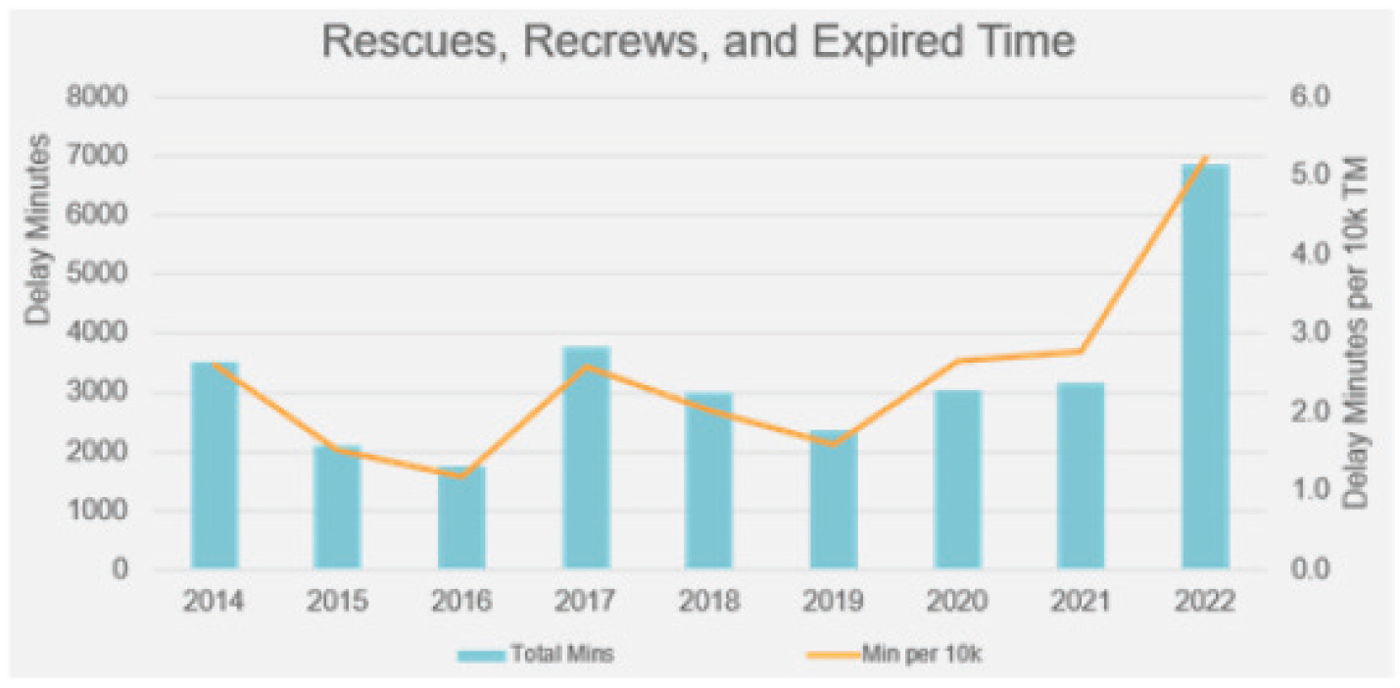
Since long trains have been implemented on a widespread basis, delays to Amtrak trains due to repairing or recrewing freight trains have increased. These delays include freight crews reaching the maximum number of hours they are allowed to work under federal law. In these instances, the crew must be replaced (“rescued”) by a fresh crew. This occurs at over-the-road locations, in addition to designated crew change locations at the end of subdivisions. In some cases, the freight train may block or delay the passage of other trains on the line, including Amtrak. The average delay per such occurrence experienced by Amtrak trains has increased from 39.1 minutes during the study period pre-2018 to 65.3 minutes during the study period post-2018 (see Table 5-2 and Figure 5-2). Much of the increase between the two study periods was caused by a spike in delay in 2022.
Meeting and Following Long Freight Trains
Long trains traveling slower for longer can compound delays for Amtrak trains caused by inadequate infrastructure for passing slower long trains.
TABLE 5-2 Amtrak Delays Due to Freight Train Breakdown Recovery Time, 2014–2022
| Year | Delays per Instance (minutes) |
|---|---|
| Pre-2018 | 39.1 |
| 2018 | 47.2 |
| Post-2018 | 65.3 |
SOURCE: Amtrak presentation to committee, February 23, 2023.
SOURCE: Amtrak presentation to committee, February 23, 2023.
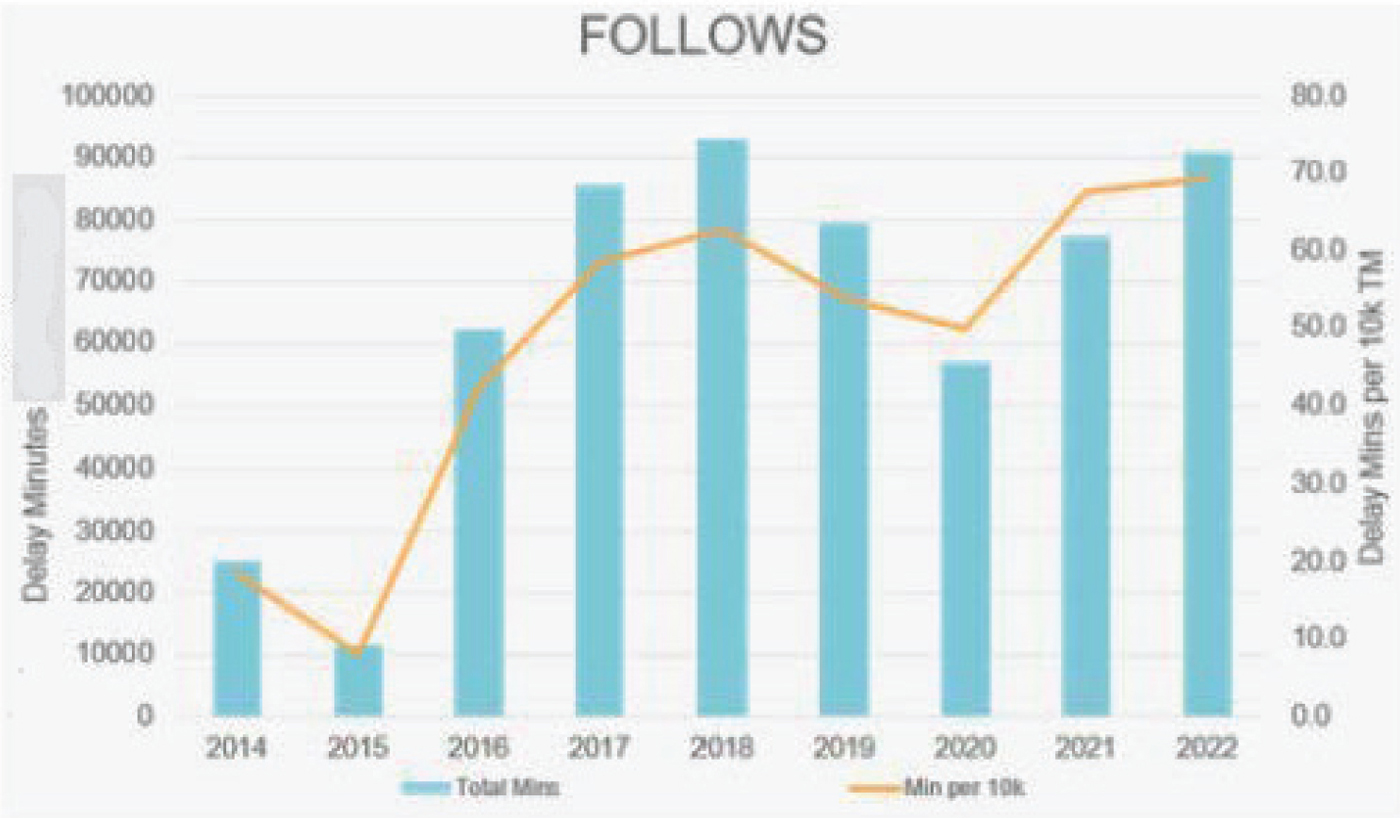
Long freight trains that do not fit in passing sidings can prevent an Amtrak train from passing a slower freight train until the freight train reaches a siding or yard with tracks long enough to accommodate it. It can take a long time before a long freight train can move out of the way of a following Amtrak train. Since 2015, Amtrak train delays from following long77 freight trains nearly doubled, from an average of 32 minutes per 10,000 Amtrak train miles78 during the study period pre-2018 to 61 minutes per 10,000 Amtrak train miles during the study period post-2018 (see Figure 5-3).
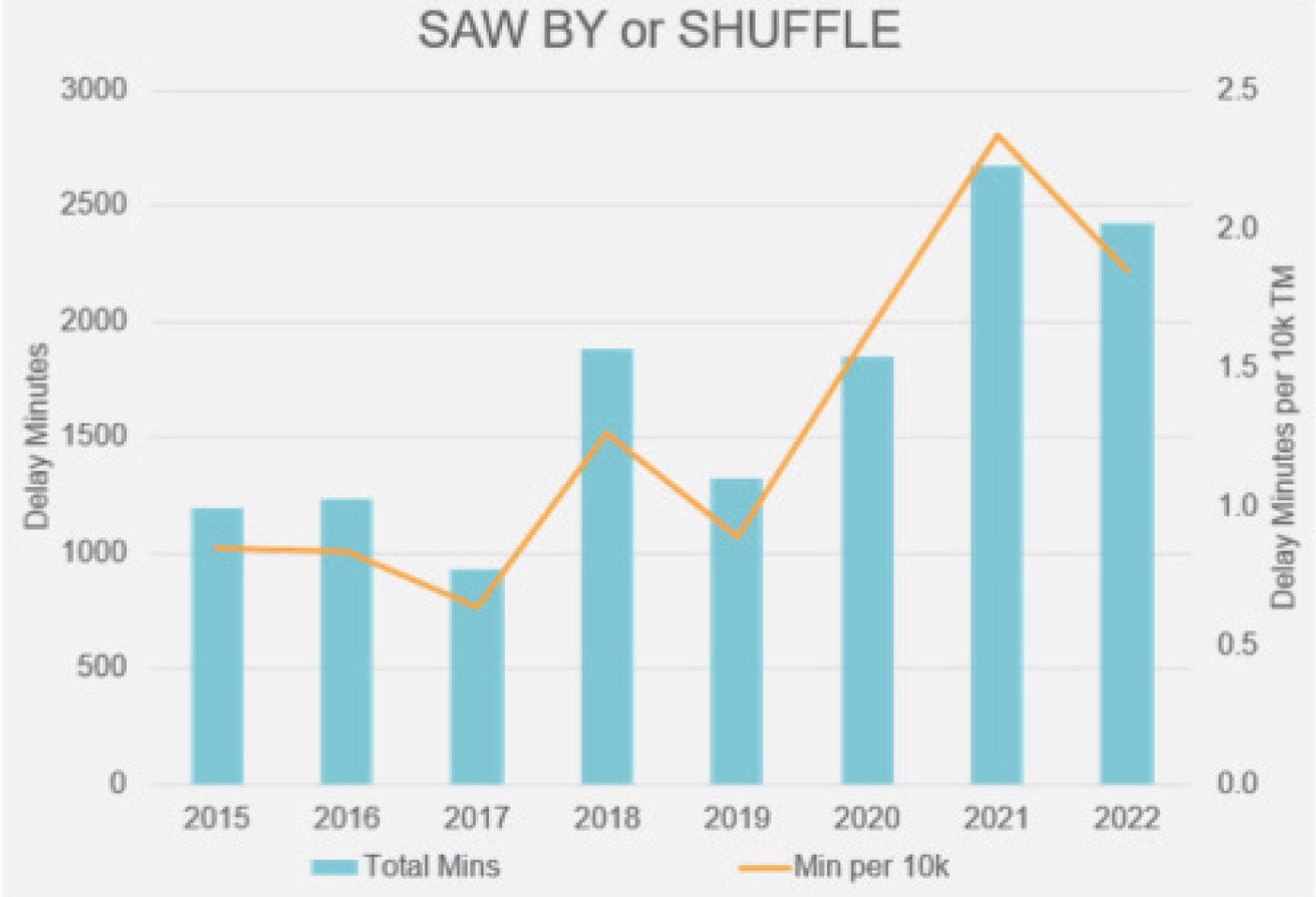
In addition, long freight trains can require complex train meets, also known as saw-by or shuffle maneuvers, so that an Amtrak train can pass.79 These complex maneuvers require Amtrak to stop while a freight train slows down and performs a reverse movement into a nearby siding or adjacent track. Figure 5-4 depicts Amtrak train delays during the study period due to such saw-by and shuffle moves, which shows a marked increase in total minutes of delay and minutes of delay per 10,000 train miles for the period of long trains.
___________________
77 Amtrak identified delays caused by long trains using applicable words and phrases as filters in their database (e.g., “non-fitter,” “too long for siding,” “no sidings long enough,” “10k/12k/15k footer”).
78 To compare delay data across routes and host railroads, Amtrak often normalizes delay minutes per 10,000 train miles (“10K TM”).
SOURCE: Amtrak presentation to committee, February 23, 2023.
SOURCE: Amtrak presentation to committee, February 22, 2023.
Slower Routing of Amtrak Trains
In addition to not fitting in sidings, long trains may also not fit into freight train yards. In situations where a long freight train is holding the mainline outside a freight yard, the host railroad dispatcher may route an Amtrak train around the freight train by sending it through the freight yard. Freight yards are not designed for passenger trains and often include slow speeds, many switches, tight curves, and narrow spaces. Operating an Amtrak train through a yard requires more time than operating on the adjacent mainline, but the host dispatcher may judge that directing an Amtrak train past a long train by sending the passenger train through the freight yard is the lesser of evils. Average annual delay in minutes of Amtrak trains from operating through freight yards has increased from 4,179 minutes during the study period pre-2018 to 6,864 minutes during the study period post-2018 (see Table 5-3).
TABLE 5-3 Amtrak Delays Due to Slower Routing Through Yards, 2014–2022
| Year | Total Delays (minutes) | Delay Length (minutes) |
|---|---|---|
| Pre-2018 | 4,179 | 11 |
| 2018 | 4,091 | 15 |
| Post-2018 | 6,864 | 17 |
SOURCE: Amtrak presentation to committee, February 23, 2023.


