Airport Parking Reservation Systems and Techniques (2025)
Chapter: 4 Airport Case Examples
CHAPTER 4
Airport Case Examples
4.1 Introduction and Case Example Findings
4.1.1 Overview and Approach to Case Examples
To further explore the potential benefits, costs, challenges, and opportunities of airport OBSs, interviews were conducted with five of the 17 airport operators surveyed. These airports are PHX, DFW, MSY, GSP, and STS.
Airports were selected based on a set of minimum criteria, which included the following:
- Airports had to be using an online parking reservation system, confirmed by survey respondents answering “Yes” to Question 2 of the survey, “Does your airport offer customers the option to reserve parking products through an online booking system?”
- Airports must have indicated their willingness to participate in follow-up interview meetings confirmed by survey respondents answering “Yes” to Question 17 of the survey, “Would you be available for additional follow up for the study?”
- Airports had to be available for interviews during April 2024 when contacted for follow up.
This process narrowed the pool of potential airport case examples from 16 airport operators to 14 airport operators. The selection was further refined to five based on the following criteria:
- Having a range of case examples that reflect a broad range of airport sizes, based on hub size according to the U.S. FAA’s 2024 definitions and enplanement volumes.
- Having a range of case examples that reflects the diversity of airport involvement in the OBS, as indicated by the ACRP project summary and the survey results outlined in Chapter 3.
Table 4.1 describes how the selected airports performed against the minimum criteria (Criteria 1 and 2) and requirements (Requirements A through C) and highlights how the airports were selected for case example interviews.
Interviews lasting between 30 minutes and one hour were conducted depending on participant availability and the level of information provided. Interview questions can be found in Appendix B. The remainder of this chapter provides the case example summaries of the five airports interviewed. Each of the case examples contain:
- An airport introduction, including an overview summarizing the structure and approach to the airport’s use of the OBS;
- A discussion of OBS benefits reported by the airport operator;
- A discussion of OBS costs;
- A discussion of OBS challenges identified by the airport operator; and
- A discussion of future opportunities for the use of the OBS under active consideration.
Table 4.1. Airport case example participants’ results against selection criteria and requirements.
| Airport | Minimum Criteria (Yes to All) | Requirements | |||
|---|---|---|---|---|---|
| A – Confirm OBS | B – Follow-Up Availability | C – Interview Availability | 1 – FAA Hub (2023) | 2 – Airport OBS Involvement | |
| PHX | Yes | Yes | Yes | Large | Automated |
| DFW | Yes | Yes | Yes | Large | High |
| MSY | Yes | Yes | Yes | Medium | Low |
| GSP | Yes | Yes | Yes | Small | Medium |
| STS | Yes | Yes | Yes | Non-Hub | Low |
Source: U.S. FAA 2024
4.2 Phoenix Sky Harbor International Airport
4.2.1 Airport Introduction and OBS Overview
Table 4.2 lists some of the summary statistics for PHX, located in Phoenix, Arizona. With annual enplanement volumes exceeding 1% of the total national enplanements, the airport is classified as a large hub by the U.S. FAA (2024).
PHX installed an OBS in 2014 and has since made several improvements (Robinson and Henning 2024). The airport outsources its parking operations to a third-party vendor, which holds a separate contract for the OBS. The airport’s goals for its OBS include improving the customer experience, accommodating growing demand, and increasing parking revenues.
Initially, the airport began discounting parking prices up to 40% to attract new users to the OBS. Over time, the average discount was reduced. The airport began adding more functionality and implementing variable pricing through a third-party vendor working with the parking
Table 4.2. Airport summary statistics.
| Category | Description |
|---|---|
| Enplanements (CY2023) | 23.9 million |
| Parking and Ground Transportation Revenue Per Enplanement (FY2022) | $5.41 |
| OBS Management Model | Parking operations are outsourced to a third-party vendor, which has responsibility for procurement, operations, and day-to-day management of the OBS. |
Source: U.S. Bureau of Transportation Statistics 2024, U.S. FAA 2024, U.S. FAA n.d.
operator. The airport took the next step of implementing an automated pricing system, pulling demand data from its PARCS and OBS and using that information to adjust pricing. There are over 140,000 customer accounts in its system.
The airport considers its relationships with its parking operator and third-party vendors as partnerships, relying on its partners’ analyses and expertise to advise on pricing decisions based on historical utilization and demand, season, day of week, weekday/weekend, and stay duration. On average, approximately 20% to 25% of its inventory across its various parking products is made available for customer reservations through its OBS.
4.2.2 OBS Benefits
Based on the interview with PHX and the survey responses (Steer 2024), key OBS benefits include:
- Improved customer experience;
- Increased revenues compared to pre-OBS integration;
- Improved and more balanced utilization of parking facilities;
- Estimated future demand data, which helped determine the amount of parking inventory to be placed in the OBS; and
- Additional CRM data and insights.
PHX strives to be “America’s Friendliest Airport” (City of Phoenix Aviation Department 2023c). According to the airport, reserved parking has contributed to elevated customer service scores through the Airports Council International Airport Service Quality instrument (Robinson and Henning 2024). The OBS has provided customers a guaranteed place to park, easing concerns about availability that otherwise would have negatively impacted the customers’ experiences.
For its parking operations team, future demand data has enabled higher levels of predictability, supporting informed planning and pricing decisions (Robinson and Henning 2024).
Increased revenues are another benefit. According to the interviewees, over the last three years, there has been increased revenue resulting from the use of variable pricing, particularly during major events such as hosting the National Football League’s Super Bowl (Robinson and Henning 2024). The OBS has also been a tool for the airport to maintain its market share over competing modes, such as ride app services. Figure 4.1 illustrates the number of parking and ride app transactions
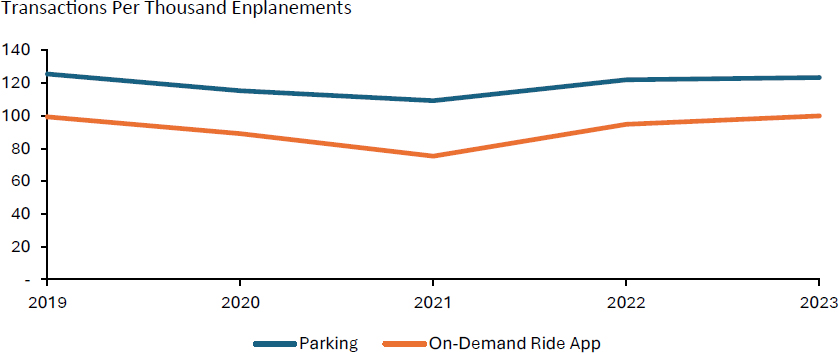
Figure 4.1. Parking and on-demand ride app normalized transactions 2019–2023.
normalized for enplanements (City of Phoenix Aviation Department 2023b). As illustrated in the graph, PHX has maintained a higher number of parking transactions per thousand enplanements over ride app services. According to the interviewees, prior to the COVID-19 pandemic, the number of parking transactions per enplanement had increased steadily (Robinson and Henning 2024). Since the initial COVID-19 outbreak, the number of parking transactions per enplanement has been recovering (City of Phoenix Aviation Department 2023b).
As illustrated in Figure 4.2, the share of online parking reservations over the total share of parking transactions at the airport has increased steadily since 2019, including through the COVID-19 pandemic. Additionally, revenue per transaction for online parking reservations has increased steadily from an average of $72 per transaction in 2019 to $87 in 2023.
Other business practices facilitated by the OBS include upselling (providing the customer with an elevated parking offer and experience during their online booking journey) and conversions (capturing customers from competing airport access alternatives). The interviewees noted that the airport’s OBS previously had functionality to upsell parking from its remote parking lots, which have lower average transaction values, to higher transaction value products, such as terminal garages. At the time of this writing, upsells were paused as the airport transitions to a new parking system.
Overall, the airport reports that the OBS has proven beneficial (Robinson and Henning 2024).
4.2.3 OBS Costs
4.2.3.1 Implementation Costs
Initial setup costs for the OBS were estimated at $21,000 (Robinson and Henning 2024). The airport has made incremental updates annually, adding system customization and functionality, such as more sophisticated variable pricing. According to Robinson, these system customizations have not exceeded $20,000 annually since initial OBS implementation.
4.2.3.2 Operating Costs
PHX’s OBS vendor charges the airport a per transaction fee between $0.65 and $1.00, with per transaction costs declining with additional volumes realized (Phoenix Sky Harbor International Airport 2024). All other OBS operating costs incurred by the operator and vendor are reimbursed
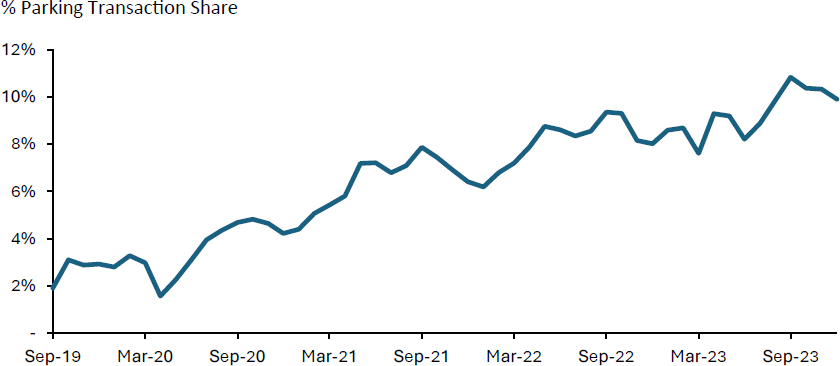
Figure 4.2. Online parking reservation market share September 2019 – December 2023.
by the Phoenix Aviation Department. To offset some of the costs of the OBS, the airport charges a $2.00 booking fee to customers, as illustrated by the booking page screenshot of Figure 4.3.
4.2.4 OBS Challenges
During the initial rollout in 2014, the airport experienced technical challenges when integrating the OBS with its PARCS (Robinson and Henning 2024).
More recently, with the transition to a more automated pricing system, the airport was cautious to manage potential customer experience impacts. In the interview, it was noted that the airport was initially hesitant to make the change due to the experience with the initial rollout (Robinson and Henning 2024). In response to these concerns, with each system upgrade, the airport employed several actions, including:
- Testing and quality assurance,
- Implementing pilot programs, and
- Soft openings and go-live launches facility by facility.
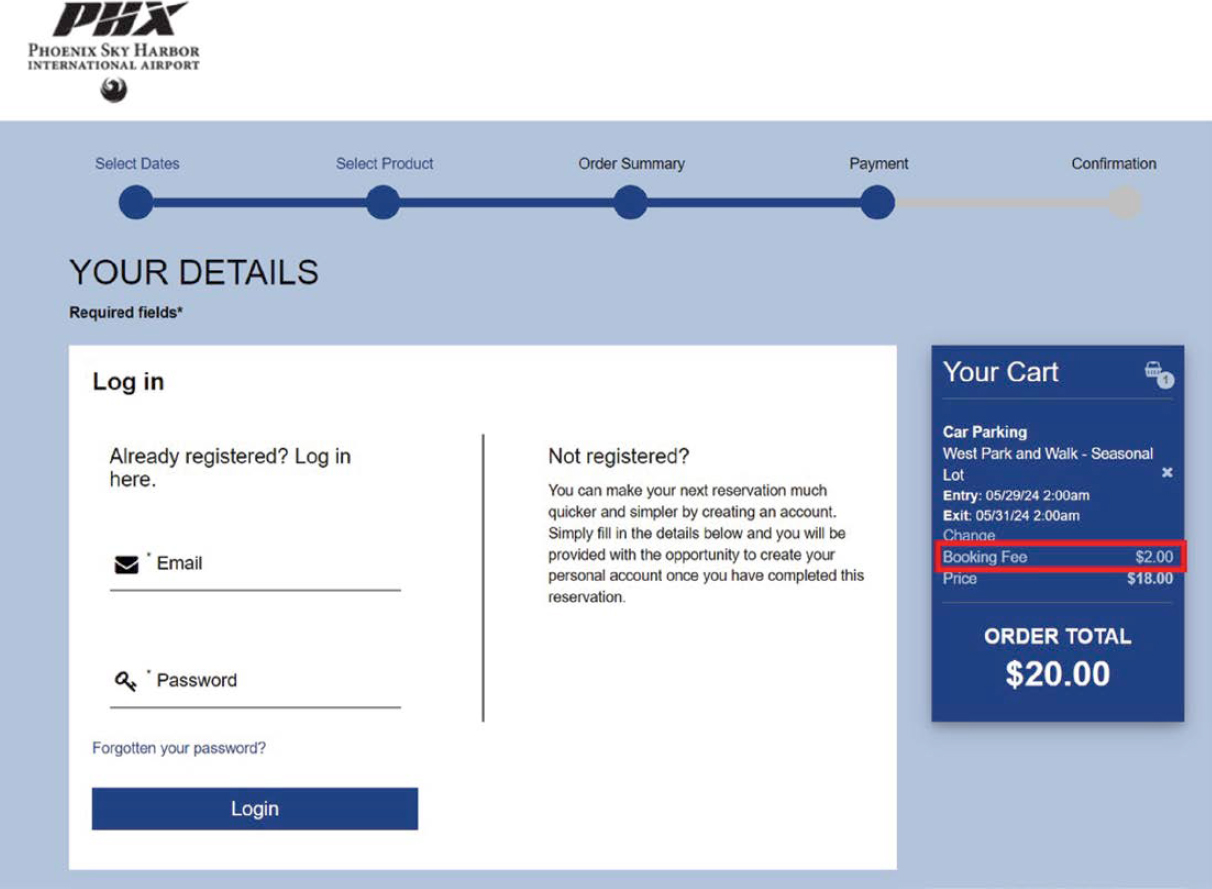
Figure 4.3. Phoenix Sky Harbor International Airport OBS booking/payment page screenshot (emphasis added).
The most recent transition took place over the course of three months before it was rolled out across the airport (Robinson and Henning 2024). PHX attributes the successful recent upgrade launch to the Aviation Department’s partnership with the parking operator and the methodical OBS ramp-up, testing, and soft opening.
Additionally, the airport has previously looked at increased selling through third-party distribution channels, airlines, and third-party reservation systems, practices commonly employed by some international airports (Robinson and Henning 2024). However, the lack of interest from airlines and per transaction commission structures favored by third-party reservation systems discouraged these practices. They remain open to other models of selling parking if viable new business models and interest emerge.
4.2.5 Future OBS Opportunities
Over the course of 2024–2025, the airport will be rolling out additional parking solutions, including a new parking guidance system in Terminal 3 as well as LPR technology to further improve the customer experience. LPR would replace the current QR code reservation and payment validation process. With an automated LPR solution, the entry and exit gates would lift automatically after the license plate is read, not requiring any additional action by the customer (Robinson and Henning 2024).
As it seeks to move from variable to dynamic pricing, the airport is looking to leverage its improvements in technology and its use of customer data to improve its forecasting models and inform future planning decisions (Robinson and Henning 2024).
4.3 Dallas Fort Worth International Airport
4.3.1 Introduction and OBS Overview
Table 4.3 lists some of the summary statistics for DFW, located in Dallas, Texas. The airport is a large-hub airport as classified by the U.S. FAA (2024).
DFW launched its OBS in 2018 (Bandla 2024). Prior to its implementation, the airport had excess parking capacity in its terminal garages; they were, on average, less than half full. Given
Table 4.3. Airport summary statistics.
| Category | Description |
|---|---|
| Enplanements (CY2023) | 39.2 million |
| Parking and Ground Transportation Revenue Per Enplanement (FY2022) | $5.44 |
| OBS Management Model |
|
Source: U.S. Bureau of Transportation Statistics 2024, U.S. FAA 2024, U.S. FAA n.d.
that business travelers were the main customers for the more expensive garages, these facilities were underutilized on weekends when a higher proportion of price-sensitive leisure travelers were traveling and seeking less expensive parking products. By using the OBS to help inform pricing decisions, airport management identified an opportunity to stimulate parking demand by reducing the price of their garage on the weekend up to 50%, increasing the number of transactions and revenues while improving utilization.
The airport began slowly implementing new features and enhancements, transitioning from a relatively fixed discount-based pricing system to more of an active variable pricing system that depended on a number of factors, including travel purpose (using weekend stay as a proxy for leisure travelers), reservation lead time, length of stay, and information on future bookings generated by the OBS (Bandla 2024). When this synthesis was written, the airport had over 200 different price points for its products at any given time.
From 2018 to today, DFW staff have analyzed demand and revenues, incorporating the pricing decisions into the airport’s OBS (Bandla 2024). Commercial management—including day-to-day pricing decisions and inventory management—financial reporting, marketing, operations, and customer support are all handled by the airport staff. The airport contracts with third-party vendors to operate its PARCS, OBS, payment processing, and website development.
The airport is planning to integrate third-party yield management tools to enable a transition from variable to dynamic pricing. However, ultimate responsibility for setting decision rules for commercial management will remain with the existing internal team.
4.3.2 OBS Benefits
According to the DFW staff, the primary benefits of DFW’s OBS include:
- Increased revenues compared to pre-OBS integration,
- Improved utilization of parking facilities,
- Estimated future demand data,
- Improved customer experience, and
- Established CRM system with data on 800,000 customers.
The airport has optimized revenues by adjusting the inventory for various parking customer segments and pricing to improve occupancy and revenue performance (Bandla 2024). According to the airport representative, while busy during peak travel periods, DFW has surplus capacity available during off-peak periods. These periods are where the airport focuses its efforts. It is estimated that the OBS generated 40% to 50% net new incremental parking revenues for the airport. Additionally, the OBS has been able to balance occupancy across different parking products, enhancing performance and improving customer experience.
The ability to set different prices has enabled the airport to compete with ride app services (Bandla 2024). During the interviews with DFW staff, it was shared that with the airport discount available through the OBS, the cost of airport parking could be as low as 50% of the cost of ride app services. Prior to the launch of the airport’s OBS, the airport’s parking market share had declined from 40% in 2014 to 36% in 2018. During that time, on-demand ride app services increased their shares from 0% to 17%. Since the launch of the OBS in 2018, on-airport parking mode share has stabilized at 36%. Therefore, the OBS has enabled growth in parking occupancy and revenues despite increasing competition.
The airport has been able to use the data generated from its OBS to develop analysis and business intelligence dashboards used to support pricing decisions by DFW staff (Bandla 2024).
4.3.3 OBS Costs
4.3.3.1 Operating Costs
The airport estimates that the total operating cost of running the OBS is approximately $200,000 annually. This includes the vendor’s OBS costs as well as staffing costs by the in-house DFW team. The airport does not pass a reservation or transaction fee on to its customers (Dallas Fort Worth International Airport 2024). According to Bandla (2024), the airport’s OBS business has been highly profitable.
4.3.4 OBS Challenges
Like airports that were early adopters of OBS, according to the airport representative, technical challenges were common over the years, particularly with integrating PARCS, OBS, and payment systems (Bandla 2024).
Additionally, airport buy-in for the system was initially challenging. By offering discounts through its OBS to attract customers, the airport recognized that it had potentially decreased revenues because customers would have paid more without the offer of a discount through the OBS. As the airport representative posed in the interview, “Why would [an airport] sell [parking for] $14 [in an OBS] compared to [a much higher drive-up cost]?”. The airport’s focus on conversions from ride app services and upselling customers from lower-revenue parking products to higher-revenue terminal garages have effectively addressed this question. Additionally, the airport has been able to increase its net parking revenues through OBS.
Overall, DFW is satisfied with its OBS.
4.3.5 Future OBS Opportunities
One of the challenges identified by the airport is existing system limitations in its OBS, as discussed in Section 4.3.4, “OBS Challenges” (Bandla 2024). To overcome these issues, the airport is in the process of transitioning to a new system, enabling it to identify and provide different types of upgrades to its customers. The airport wants the new system to reduce the number of system integration issues between its OBS and PARCS, and it hopes to transition from variable pricing to more active dynamic pricing.
4.4 Louis Armstrong New Orleans International Airport
4.4.1 Airport Introduction and OBS Overview
Table 4.4 lists some of the summary statistics for MSY, located in Kenner, Louisiana, approximately 11 miles west of Downtown New Orleans. With enplanement volumes between 0.25% and 1% of the total U.S. annual passenger boardings, the airport is classified as a medium-hub airport by the U.S. FAA (2024).
According to MSY, its OBS is seen as “another tool in the toolbox” for parking and ground transportation (Krygowski 2024). Changes in customer demographics and consumer preferences motivated the airport to implement its OBS. Planning for a new OBS began in 2017, when the airport issued its parking operations request for proposal. The airport’s OBS was implemented in 2022. The contract for its parking reservation system is held by its parking operator.
MSY has focused on using its system as a customer experience tool, providing a guaranteed parking space (Krygowski 2024). The airport has begun using its system to collect customer data into its CRM but has not yet used the data for marketing purposes or to push offers to its customers.
Table 4.4. Airport summary statistics.
| Category | Description |
|---|---|
| Enplanements (CY2023) | 6.3 million |
| Parking and Ground Transportation Revenue Per Enplanement (FY2022) | $4.07 |
| OBS Management Model | Parking operations are outsourced to a third-party vendor, which has responsibility for procurement, operations, and day-to-day OBS management. |
Source: U.S. Bureau of Transportation Statistics 2024, U.S. FAA 2024, U.S. FAA n.d.
4.4.2 OBS Benefits
According to the airport representative, key benefits include:
- Estimated future demand data,
- Improving customer experience, and
- Improving utilization of parking facilities.
The lack of parking capacity during peak periods was an operational challenge that affected the customer experience between 2015 and 2018; at that time, the airport was still operating from its old terminal concourses. In conjunction with the development of its new (and current) terminal concourses, the airport now has over 10,000 parking spaces. Given the prior facility’s parking constraints, providing available capacity and offering a guaranteed parking space were seen as key customer amenities that the airport has chosen to continue.
According to the interviewees, MSY uses the OBS to capture customers and determine how much inventory to make available for parking products through the OBS. They have not yet used its system as a revenue management tool to offer discounts and/or to vary prices by occupancy levels (Krygowski 2024).
As the airport’s OBS was implemented in 2022, it does not yet have data that quantifies the impact of its OBS to competing mode shares (Krygowski 2024). However, the airport has increased the inventory made available for parking reservations from 10% to 20% of its parking capacity due to customer demand.
4.4.3 OBS Costs
4.4.3.1 Operating Costs
The costs of the OBS are recovered through a per reservation transaction fee charged by the OBS contractor. A $2 fee is passed along to the customer for each transaction (Krygowski 2024).
4.4.4 OBS Challenges
Implementation was a key challenge (Krygowski 2024). There were several technical and system integration issues, including between the PARCS and OBS, as well as with the payment
systems. The reliability of the LPR for entry and exit validations was deemed inadequate, so the airport put in place QR code readers. However, these had issues as well. Due to user errors with scanning their reservation QR codes or barcodes, the airport and its parking operator jointly developed instructional signage that explained how customers should properly scan QR codes or barcodes. The partnership helped the airport overcome these customer experience challenges.
4.4.5 Future OBS Opportunities
Opportunities that have been recently considered by the airport include the potential offering of ancillary services, including a car washing service and car detailing offered through the OBS and provided by a third-party vendor (Krygowski 2024). While the airport has a valet product, it does not yet offer reservations for it, which it may consider for the future. As the airport expands its customer database, the airport has also identified future opportunities to push promotions and offers to its customers.
4.5 Greenville-Spartanburg International Airport
4.5.1 Airport Introduction and OBS Overview
Table 4.5 provides some of the summary statistics for GSP, located between the cities of Greenville and Spartanburg in Greer, South Carolina. The airport is classified as a small hub by the U.S. FAA, with annual enplanement volumes of between 0.05% and 0.25% of the total national passenger boardings (U.S. FAA 2024).
According to the airport, OBS oversight and management are done directly by the airport’s commercial department (Bauman 2024). The parking operator has access to the OBS and has day-to-day operational responsibilities, such as issuing refunds and assisting customers with re-bookings. The airport oversees all rate setting and revenue generation as well as its marketing and its loyalty programs.
The airport’s current system was implemented in 2021, replacing the basic prebooking system that was used directly by the parking operator, which was comparatively underutilized (Bauman 2024).
Table 4.5. Airport summary statistics.
| Category | Description |
|---|---|
| Enplanements (CY2023) | 1.3 million |
| Parking and Ground Transportation Revenue Per Enplanement (FY2022) | $13.75 |
| OBS Management Model |
|
Source: U.S. Bureau of Transportation Statistics 2024, U.S. FAA 2024, U.S. FAA n.d.
4.5.2 OBS Benefits
According to the airport representative (Bauman 2024) and survey responses, key benefits of the OBS include:
- Improved customer experience,
- Improved utilization of parking facilities,
- Estimated future demand data, and
- Increased revenues compared to pre-OBS integration.
Offering a parking reservation to capture a future customer is a key strategy for the airport. To increase its revenues from parking, GSP also used its OBS to push upgrade offers for customers who initially choose the economy lot. On a subsequent page in the booking journey, the OBS then offers them an upgrade to one of its two garages adjacent to the terminal. The airport also offers upgrades from terminal garages to valet, discounting its valet product to free up capacity for its terminal garages. The airport believes that its OBS has enabled it to optimize parking utilization across all its parking products (Bauman 2024).
According to the airport, it is estimated that the OBS generates between $150,000 to $200,000 in additional revenue from upgrades. Additionally, OBS transactions tend to have higher transaction values over drive-up transactions, which has given the airport the ability to promote discounts. This, in turn, has led to increased overall revenue. Overall, the airport is satisfied with its OBS.
4.5.3 OBS Costs
4.5.3.1 Operating Costs
GSP pays the OBS provider a $0.50 per transaction fee for each booking and customer registration. The airport does not pass the costs directly in the form of a reservation fee. However, the airport does not refund cancelled parking reservations unless the customer opts to purchase a cancellation protection add-on of $1.00 available at the time of booking, as illustrated in the airport’s booking/payment page screenshot in Figure 4.4 (Greenville-Spartanburg International Airport 2024). At the time of writing, the revenue generated from this cancellation fee covers monthly operating costs.
Gross margin of each commercial business at GSP is a key metric tracked by airport management (Bauman 2024). While the airport recognizes that operating expenditures have increased following the implementation of their OBS, the airport estimates that parking net revenue margins have increased between 10% and 15% since GSP staff took responsibility for system implementation.
4.5.4 OBS Challenges
With its previous parking OBS, the airport had challenges attracting customers (Bauman 2024). When the airport took over the responsibility of the system, it began marketing and promoting the system, enabling GSP to increase utilization of the reservation system and build a customer database.
Similar to other airports, GSP staff experienced initial system integration issues between their OBS and PARCS (Bauman 2024). The airport also had to make calibrations between its PARCS and parking guidance system to ensure counts of parking customers were correct. These calibrations then enabled more accurate occupancy estimates for its garage products and decisions to increase available inventory for the OBS.
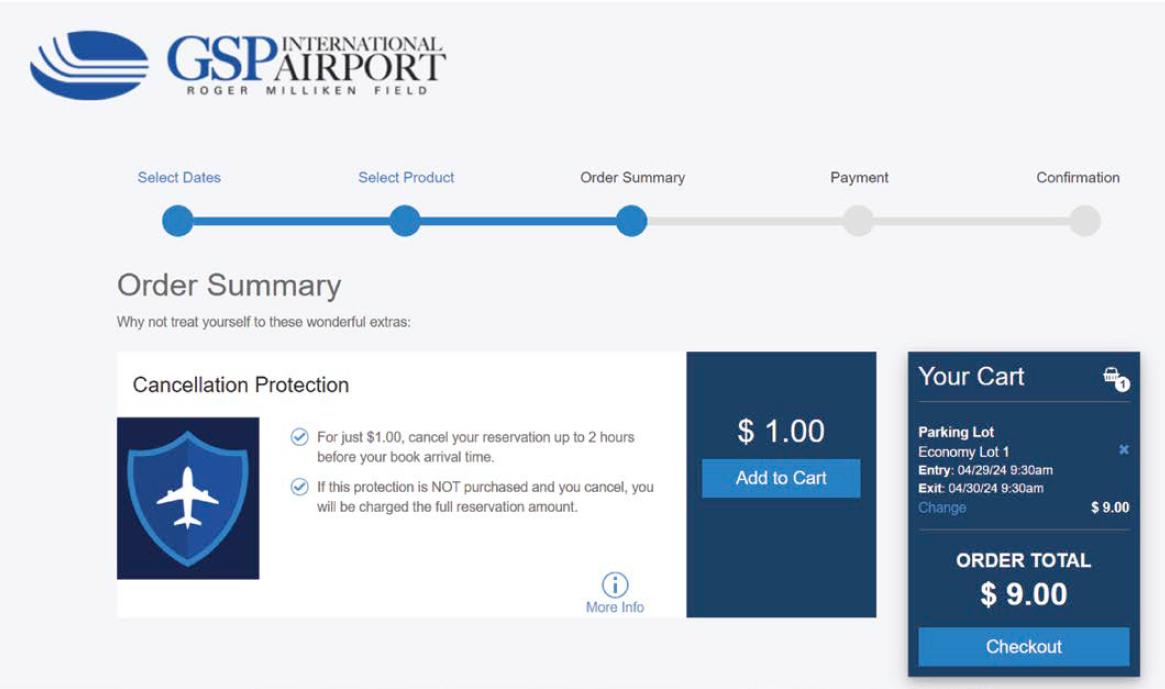
Figure 4.4. GSP International booking/payment page screenshot.
4.5.5 Future OBS Opportunities
In the future, the airport plans to transition from its current system to a more advanced variable or dynamic pricing and utilize more sophisticated revenue management, possibly by contracting with a private provider for those services (Bauman 2024). The airport is also considering using the platform to sell and/or promote other ancillary services, such as car washing and security line reservations.
4.6 Charles M. Schulz Sonoma County Airport
4.6.1 Airport Introduction and OBS Overview
Table 4.6 lists some of the summary statistics for STS, located to the northwest of Santa Rosa, California. The airport is classified as a non-hub by the U.S. FAA (2024).
The airport outsources its parking operations to a third-party provider, who holds the contract for the airport parking OBS (Schandel 2024). The airport implemented its OBS in 2021 after experiencing significant growth in enplanements and parking demand. The airport has bimonthly meetings with its parking operator to review parking operational decisions, including the use of its OBS platform.
The airport uses fixed pricing and does not discount or otherwise vary parking prices (Schandel 2024).
Table 4.6. Airport summary statistics.
| Category | Description |
|---|---|
| Enplanements (CY2023) | 318,000 |
| Parking and Ground Transportation Revenue Per Enplanement (FY2022) | $7.76 |
| OBS Management Model | Parking operations are outsourced to a third-party vendor, which has responsibility for procurement, operations, and day-to-day management of the OBS. |
Source: U.S. Bureau of Transportation Statistics 2024, U.S. FAA 2024, U.S. FAA n.d.
4.6.2 OBS Benefits
Key benefits for the airport from the OBS include:
- Improved customer experience, and
- Estimated future demand data.
According to the airport, given the growth in passenger volumes, which often leads to full parking lots, the OBS and parking reservations have enabled customers to secure a guaranteed parking spot, thereby improving the customer experience. This remains important as STS is expecting additional growth in airline service and further pressures on its parking capacity. The future demand data from the OBS has also enabled the third-party parking provider to assess demand and decide how much parking inventory to place in the OBS for select days. It also reportedly supports operational decisions.
4.6.3 OBS Costs
4.6.3.1 Operating Costs
As the operating costs of the OBS are part of the management fee with the third-party parking provider, specific OBS costs were unavailable (STS Parking 2024). However, as per the airport’s survey response, the fees include a $2.99 reservation fee assessed on customer reservations, which are passed along to the OBS vendor to pay for their costs of the system. Additionally, as shown in Figure 4.5, the airport offers $1.00 optional cancellation protection coverage and uses the OBS to offer a carbon offset product for its “good travelers.”
4.6.4 OBS Challenges
According to the airport, its parking operator and OBS vendor provide ongoing customer service support (Schandel 2024).
4.6.5 Future OBS Opportunities
At this time, new OBS opportunities are not being considered by the airport (Schandel 2024).
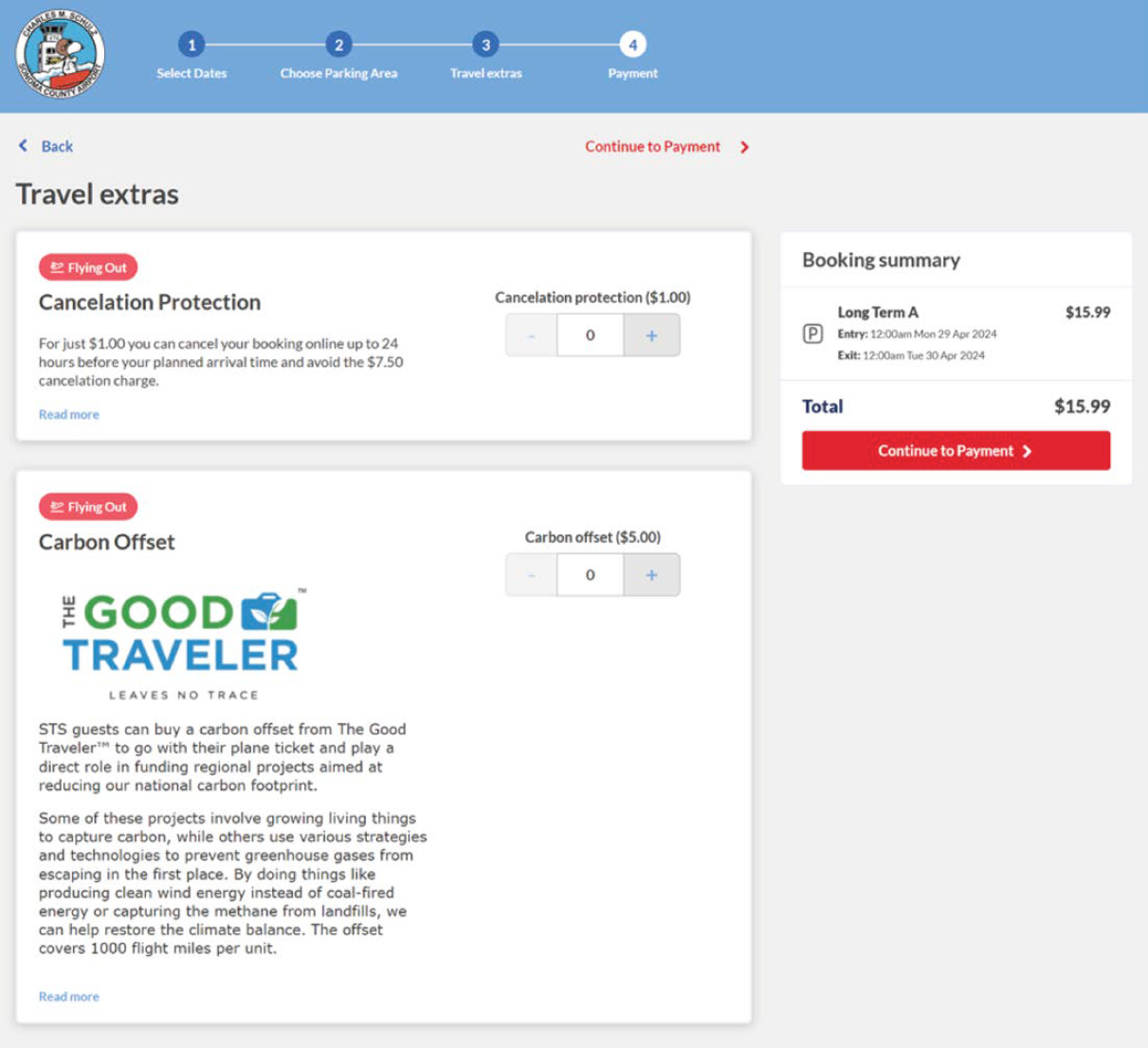
Figure 4.5. STS Airport booking/payment page screenshot.


