Pay and Working Conditions in the Long-Distance Truck and Bus Industries: Assessing for Effects on Driver Safety and Retention (2024)
Chapter: Executive Summary
Executive Summary
This report considers how compensation methods and working conditions in the long-distance for-hire trucking and intercity bus industries may affect the safety performance and retention of industry drivers. If there is good reason, based on a review of the empirical evidence and any identified limitations of that evidence, the report is expected to contain recommendations for data-gathering, analytic methods, and research designs that may be helpful for understanding the effects.
A for-hire trucking company transports freight as its main line of business, as opposed to an in-house private carrier that transports the goods of its parent company. For-hire trucking is a large and heterogeneous industry with considerable variability in carrier sizes, operational structures, and freight markets served. This report focuses on the for-hire industry’s long-distance truckload (TL) sector, which involves the movement of semitrailer-sized shipments of freight from origin to destination over distances of 150 miles or more. With rare exception, drivers in this sector are compensated in a piece rate manner that is based on output produced, such as loads transported and miles driven to deliver a load. Because drivers are not paid according to hours worked, this can raise concerns about whether drivers who are intent on providing that output (i.e., delivering the load) in a timely manner, perhaps to return home or pick up another paying load, may engage in unsafe driving behaviors, such as by speeding to maximize miles driven within regulated driving hours.
Key to understanding the long-distance TL sector is that there are three basic kinds of drivers, and their compensation is structured differently, albeit piece rate in nature. The majority of TL drivers are employed directly
by a carrier and operate that carrier’s equipment (i.e., truck tractor and semi-trailer). They are referred to as company drivers and are usually paid according to miles driven. Other drivers are referred to as owner-operators because they own and operate their own equipment. These drivers may lease their driving services and equipment to a carrier (i.e., “leased-on” drivers) and operate under that carrier’s authority or they may operate independently under their own authority in the manner of a small TL carrier. Leased-on drivers usually receive payments from the contracting carrier that are based on miles driven or a portion of the fee charged for the tendered load. Drivers operating independently in owner-operator service obtain their own revenue-generating loads, and this revenue must be used to recoup their equipment, overhead, and operating costs, including their time spent driving. Company drivers are therefore more aptly described as being paid by an employer for work, whereas owner-operators, especially those operating independently, are more aptly described as being renumerated for a supplied service. Although they differ in many fundamental respects, nearly all long-distance TL drivers are compensated in a piece rate manner that is load- and mileage-basis.
Because carriers in the long-distance TL sector compete largely by offering low-price service, piece-rate compensation that is based on a defined output (i.e., delivering a load a given distance) is intended to incentivize driver work effort while also guaranteeing that a carrier or shipper tendering a load will pay a pre-set amount for the driving. The irregularity of available loads for truck transport, however, can lead to drivers earning inconsistent pay on a weekly and monthly basis. Irregular earnings, coupled with working conditions that can be stressful when drivers must scramble for paying loads, contributes to the persistently high rates of driver turnover shared by nearly all long-distance TL carriers. Operating in a highly competitive industry that requires efficient dispatching as well as low costs to secure business, TL carriers find they must accept high rates of driver turnover to remain profitable, even as they incur recruitment, hiring, and training costs.
Drivers of intercity passenger buses also work for carriers in widely varying motorcoach operations, including driving on scheduled routes, irregular routes in charter operations, and single-day and multi-day tours where drivers may also serve as guides and lodge overnight with passengers. Therefore, it is not possible to generalize about the working conditions of these long-distance drivers as a group, but their pay is usually hourly based and may include other forms of compensation such as gratuities. While expectations for bus drivers to stay on schedule within regulated driving hours may seem to create incentives for faster driving, hourly pay may allay time pressures, while the presence of passengers on the bus can also provide an additional check on aggressive driving behaviors.
Motor carrier compensation schemes and records are often proprietary, regardless of the trucking and bus industry segments under review. While this situation complicates and adds to the effort required for assessing how compensation methods can affect driver retention and safety performance, a more fundamental challenge is that compensation methods are largely uniform in the long-distance TL sector (mostly variants of piece-rate pay) and in the intercity bus sector (mostly hourly pay) so as to present limited opportunities to observe their respective effects by comparing the experience of carriers in the same business that use different pay methods. Furthermore, because the working conditions of drivers in the intercity bus industry differ markedly from the working conditions of drivers in the long-distance trucking industry, inter-industry comparisons of the effects of compensation on the safety performance of each would not be insightful.
Where hourly pay and other non-piece-rate forms of compensation are used to some degree in other long-distance trucking sectors, such as private and less-than-truckload (LTL) carriage, the working conditions of these sectors differ markedly from those of long-distance TL operations. Whereas drivers in the TL sector work irregular schedules, operate over varied and often unfamiliar routes and spend extended time away from home, drivers who work for private and LTL carriers are more likely to operate over regular and familiar routes and on work schedules that are less varied and more predictable. Due to these significant differences in the structure and working conditions of the three major long-distance trucking sectors, the analytical value of comparing them to understand the effects of different pay methods on driver retention and safety is highly limited.
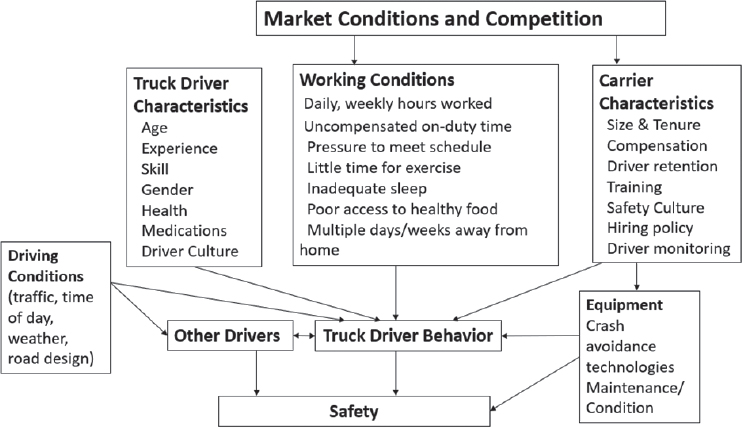
As shown in Figure ES-1, a multitude of factors related to the driver, carrier, and environment can have a bearing on the safety of trucking, complicating efforts to isolate the safety-related effects of individual factors such as compensation. The Federal Motor Carrier Safety Administration (FMCSA), which oversees and regulates the safety of the motor carrier industry, has responsibility for furthering understanding of these many factors and their interactions to inform guidance and interventions in the quest for increasingly higher levels of safety. Data collection and research are key to building that understanding, but in a strategic manner that accounts for the fuller context of factors as necessary to make confident assessments about the influences of each.
Having focused on understanding the effects of driver compensation and working conditions but not on the many other factors that can have a bearing on safety, the study committee cannot know how FMCSA should prioritize its data collection and safety research. Nevertheless, the study committee, informed by its findings, is expected to advise on whether further actions by the agency to strengthen this understanding would be desirable, potentially to include recommendations on appropriate data-gathering,
analytic methods, and research designs for this purpose. The study’s central conclusions, distilled from the study findings, are therefore presented next, followed by recommendations for FMCSA research and data gathering.
The recommendations are offered cognizant of this study’s narrow focus and limited view into FMCSA’s other data collection and research priorities. The emphasis, therefore, is on looking for potentially cost-effective opportunities to leverage future research and data collection, including work initiated for other reasons, in ways that can inform studies of driver compensation and working conditions and their potential for safety effects. Consistent with this advice, some ideas for future data gathering and studies are provided in the final chapter of this report, including thoughts on their practicality.
KEY CONCLUSIONS
The available data and empirical research are insufficient to determine whether driver working conditions and compensation methods (and their implications for pay levels and regularity) affect the driving behavior and safety performance of drivers in the long-distance TL sector. While the proprietary nature of carrier compensation offerings complicates data collection for this research, a more fundamental challenge is that driver compensation methods (i.e., variants of piece-rate pay) and basic work requirements and conditions (e.g., irregular schedules, varied routings, extended time away from home) are largely uniform
across the TL sector so as to severely limit the ability to compare the effects of alternative compensation methods (i.e., hourly and other non-piece-rate pay) and working conditions. Moreover, even if hourly pay and other non-piece-rate compensation became more prevalent in long-distance trucking, it is likely that comparisons of drivers paid by the hour with drivers paid by piece rate would be confounded by differences—many unobservable—in driver characteristics and work requirements.
Despite the nearly universal use of variants of piece-rate pay and considerable uniformity in working conditions among carriers in the long-distance TL sector, there is observed variability in carrier-level safety performance, including in rates of carrier compliance with traffic and motor carrier safety laws and regulations. Understanding the causes of this variability might be helpful for designing interventions to improve safety performance; however, even if firm causal relationships cannot be established, research to understand associations among carrier-level characteristics and safety performance may be helpful for informing FMCSA’s safety monitoring and enforcement priorities and reveal starting points for further research on causes.
Long-distance TL carriers experience universally and persistently high rates of driver turnover, which is consistent with the highly competitive nature of this trucking sector, as carriers are compelled to drive down their costs and search widely for paying loads to secure sufficient business. The sector’s observed uniformity of driver compensation methods (largely variants of piece-rate pay) and working conditions (characterized by dispatching that leads to irregular work schedules) suggests that efforts by a TL carrier to reduce driver turnover by varying too far from this uniformity, such as by introducing alternative pay and driver dispatching methods, will reduce its ability to compete.
Drivers of intercity passenger buses have consistently strong safety records as a group and are usually paid by the hour, which creates analytic challenges for comparing the effects of different pay methods. However, the role of driver compensation and working conditions in explaining this performance has not been a matter of notable concern or inquiry and would require data that are not currently available to assess. Furthermore, intercity bus driver job requirements and working conditions differ far too much from the requirements and conditions of long-distance truck drivers to allow for meaningful comparisons between the two groups.
RECOMMENDATIONS
On the basis of these study findings and central conclusions, the committee offers the following two recommendations:
Recommendation 1: The Federal Motor Carrier Safety Administration should explore opportunities for leveraging research and data collection that may be planned and programmed for other purposes to help regulators, researchers, and industry examine the potential effects of driver compensation and working conditions on the safe driving behavior and performance of long-distance truck drivers. The focus should be on exploiting new data collection efforts, resourcefully and creatively tapping or enhancing existing sources of data, and supporting discrete, smaller-scale studies for identifying patterns and associations and possibly understanding causal relationships.
Recommendation 2: The Federal Motor Carrier Safety Administration should support further research to obtain a better understanding of why safety performance varies among truckload carriers despite uniformity in compensation methods and working conditions, ideally to make progress in identifying and understanding the underlying causes of these differences but also to detect patterns and associations that may inform safety monitoring and enforcement strategies.
The final chapter of this report offers ideas for research and data collection that FMCSA could pursue for furthering these recommended actions.


